Project completed April 2026 · Los Altos, CA 94022 · Job Value: $48,829
Nobody picks up a letter from their insurance company expecting good news. When a Los Altos homeowner opened a notice from AAA stating that their homeowners insurance would not be renewed in April due to “deferred maintenance” of the roof, the news stung. The roof had been on the back burner — something to deal with eventually.
Now eventually had arrived.
What followed was actually one of the more technically interesting roof projects our team has worked on in Los Altos: a complete dual-system replacement covering both the main steeply-pitched structure and a flat-roof extension, totaling $48,829 — and resulting in a home that’s fully insurable, structurally sound, and frankly, a lot nicer than before.
What We Found: A Tale of Two Roofs
The property in Los Altos has what many older Bay Area homes have — two distinct roof systems built at different times, now aging on different schedules.
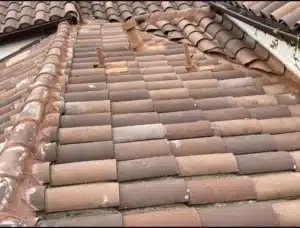
The main roofline was covered in original wood shake shingles — a classic choice from a previous era that was common throughout Los Altos and the Peninsula. Wood shake can be beautiful when maintained, but it requires regular cleaning, sealing, and inspection to stay viable. Over time, shake is prone to moss, cupping, cracking, and eventual splitting. It also doesn’t play well with modern insurance underwriters, who increasingly flag it as a fire and moisture risk. By the time our crew assessed this roof, the shake had reached the end of its serviceable life.
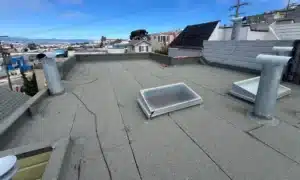
The flat roof section covering the home’s addition was a different story — and a worse one. Approximately 20 years old, it had been patched in multiple areas over the years to stop recurring leaks. Flat roofs don’t drain the way pitched roofs do; water pools, finds seams, and eventually wins. Once a flat membrane has been patched enough times, you’re putting band-aids over band-aids. Our assessment confirmed the membrane needed a full replacement, not another repair. Wondering when repair makes sense versus replacement? Our flat roof guide walks through the decision.
The Recommendation: Complete Replacement on Both Systems
Some roofing contractors would have proposed just enough work to satisfy the insurance company’s notice. We recommended what the home actually needed: a full tear-off and replacement of both roof systems.
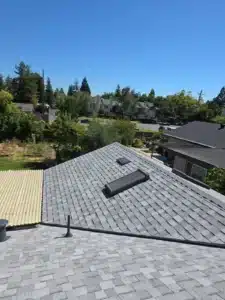
For the steep-slope portion, we replaced the wood shake with architectural shingles — dimensionally thicker than standard 3-tab shingles, with a layered aesthetic that complements Los Altos home styles and provides significantly better wind and impact resistance. Architectural shingles are also what insurance carriers prefer to see, which was directly relevant to this homeowner’s situation.
For the flat roof extension, we installed a fresh low-slope membrane system — properly underlaid, sealed at all transitions and penetrations, and designed to handle the ponding-water dynamics of a flat surface rather than fighting them with patches.
The homeowner approved the full scope. The work was scheduled and completed in March and April 2026.
The Project: Drone Coverage, Dual Crews, Dual Systems
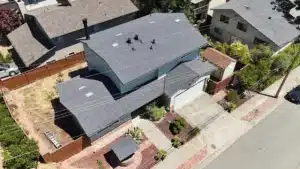
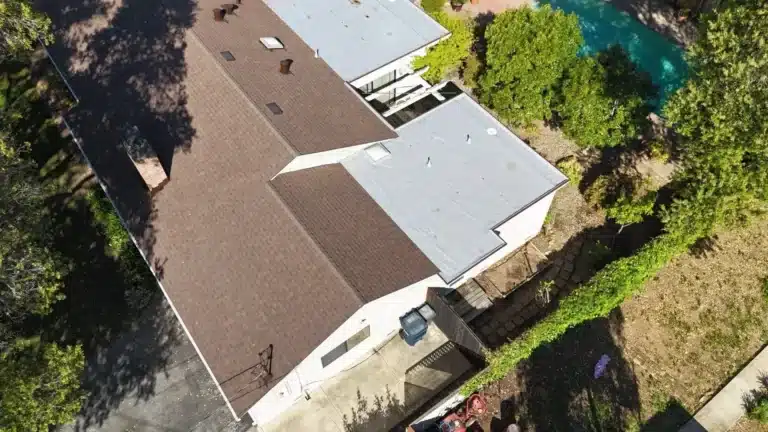
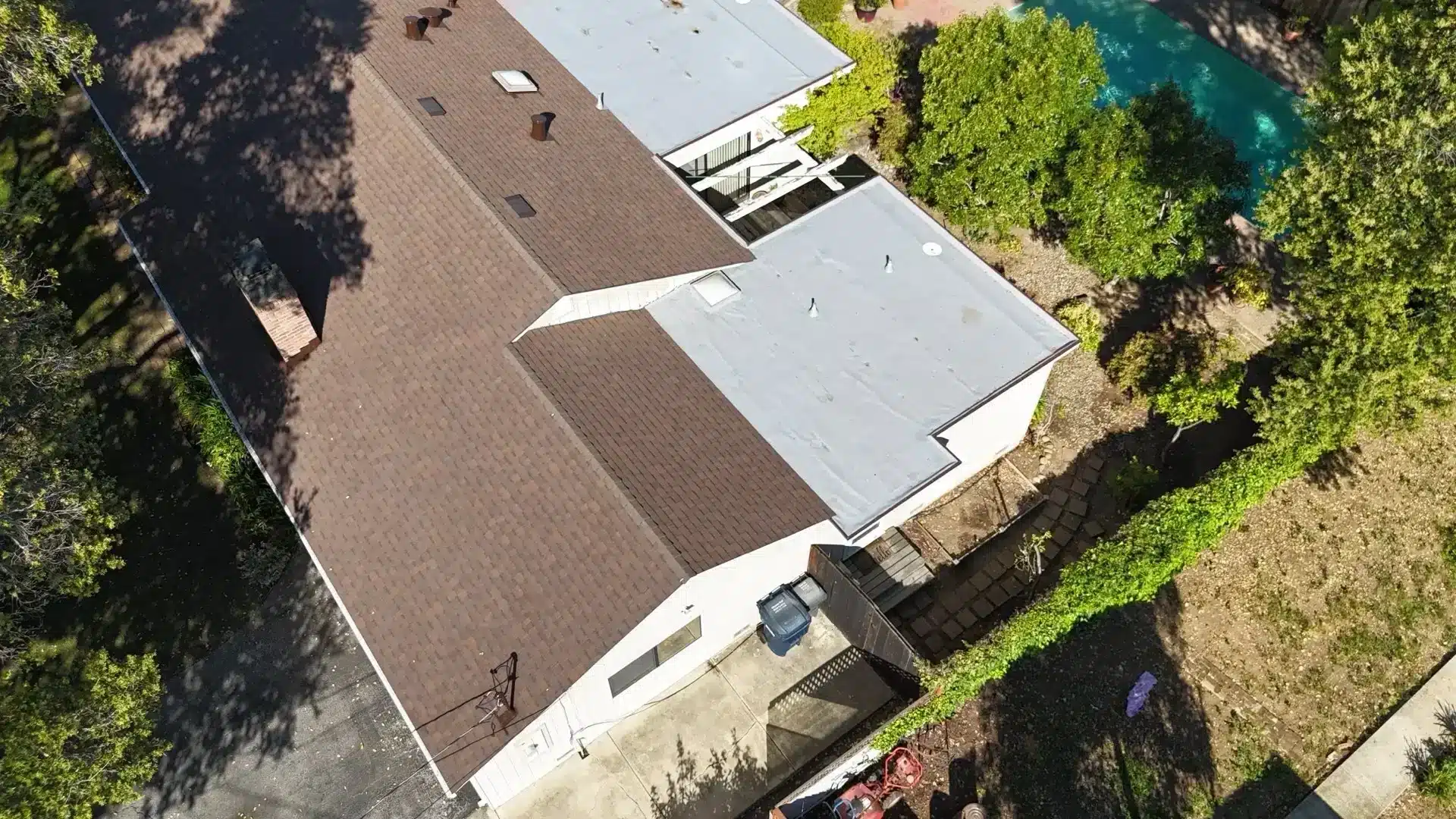
Our team documented this project with drone photography throughout — 68 photos in total capturing the roof from every angle before, during, and after. If you’ve ever wondered what a full roof replacement looks like from above, this job is a good example of the scope involved.
Working on a property with two different roof types means two different crew specialties, two different material supply chains, and careful sequencing to make sure the transitions between the steep-slope and flat-roof sections are properly integrated. The flat membrane has to tie correctly into the base of the pitch; water has to be directed away from that seam, not into it. We’ve done enough of these dual-system jobs in the Bay Area to know where those details matter most.
Total project cost: $48,829, paid in full at completion. No open balance, no disputes — a straightforward paid-and-closed outcome for both the homeowner and for us. You can see this project and others in our completed roofing projects gallery.
The Outcome: Insurable, Solid, Done
The AAA letter that started this whole process was, in retrospect, a favor. The homeowner now has:
- A modern architectural shingle roof that will perform well for decades with normal maintenance
- A properly installed flat membrane with no active patches or leak-prone seams
- Full insurability — the “deferred maintenance” finding is resolved
- Documentation of the completed work (we provide full photo records) for future insurance or resale purposes
This property is in one of the more desirable pockets of Los Altos, and a clean roof with a documented replacement record is a meaningful asset when it comes to both insurance renewals and eventual resale.
Frequently Asked Questions
Can an insurance company really cancel my homeowners insurance because of my roof?
Yes — and it’s becoming more common in California. Insurance carriers like AAA, State Farm, and others have tightened their underwriting standards significantly, particularly for fire-prone regions and aging roofs. A letter citing “deferred maintenance” on your roof is a non-renewal notice, not a cancellation mid-policy — but the practical result is the same: you need to fix the roof or lose coverage. Many Los Altos and Bay Area homeowners have received similar letters in recent years. For more answers about roof repairs, insurance inspections, and what to expect, see our roofing repair FAQ.
What’s the difference between a flat roof repair and a flat roof replacement?
A repair patches a specific failure point — a seam, a penetration around a vent pipe, a corner that’s lifted. A replacement removes the existing membrane down to the deck, inspects the substrate, and installs a complete new system. If a flat roof has been repaired multiple times, replacement is almost always the better long-term investment: you eliminate the source of recurring failures rather than chasing them around the surface.
How much does a roof replacement cost in Los Altos?
Los Altos roof replacement costs vary significantly based on roof size, pitch, number of layers being torn off, material selection, and whether the project involves one or two roof systems. This project — a dual-system replacement on a single-family residential home — came in at $48,829. Projects in the Los Altos area typically run between $20,000 and $70,000+ depending on scope. We provide free on-site estimates with no obligation.
What roofing materials are best for Los Altos homes?
Architectural (dimensional) asphalt shingles are the most common choice — they’re durable, insurance-friendly, cost-effective for the performance they deliver, and available in colors that complement both traditional and contemporary Los Altos home styles. For flat or low-slope sections, a TPO or modified bitumen membrane system is typically the right call. We assess each home individually and recommend materials based on the specific roof geometry, budget, and HOA or insurance requirements.
Do you serve Los Altos Hills as well as Los Altos?
Yes — we work throughout Los Altos, Los Altos Hills, and the surrounding Santa Clara County communities, as well as across the Bay Area from San Francisco to Watsonville. If you’re in the area and have roofing questions, we’re happy to take a look.
Considering a Roof Replacement in Los Altos?
If you’ve received an insurance non-renewal notice, noticed recurring leaks, or simply know your roof is overdue for attention, the best first step is an honest assessment. We don’t upsell — if your roof can be repaired, we’ll tell you. If it needs replacing, we’ll tell you that too, with the documentation and drone photos to back it up.
Also worth reading: How a San Jose homeowner replaced a $73,000 roof around an active solar array — another recent Bay Area project that started as a single leak call.
Schedule a free roof inspection →
Lifetime Roofing & Renovation serves Los Altos, Los Altos Hills, Sunnyvale, Mountain View, Cupertino, San Jose, and communities throughout the Bay Area. Licensed, insured, and locally operated.
Gina K. writes about Bay Area roofing for Lifetime Roofing & Renovation, drawing on the team's 16+ years of experience roofing homes across Silicon Valley.