
Industrial-grade leak protection for San Jose & Bay Area homes and businesses. We provide 60–90 minute emergency dispatch to secure your San Jose or Bay Area property from secondary water damage, wind exposure, and structural breaches.
When a roof is breached, every minute counts, so our crews follow a strict engineering protocol: a rapid thermal or visual scan identifies the primary breach and maps the zonal path of the water — not just the hole — then we clear storm debris, loose gravel, and damaged shingles so the tarp seals watertight and won't lift in high winds. Every job ends with a timestamped photo report of the damage, which is critical for your insurance claim because it proves you took immediate action to mitigate secondary damage. Crews are licensed (CA Lic. #1090028), $2M insured, and available 24/7 at (408) 685-2177. For what a same-week emergency response looks like, see how fast a tile roof leak in Richmond was fixed.
When a roof is breached, every minute counts. Our crews follow a strict engineering protocol to stop active leaks and stabilize the structure.
A rapid thermal or visual scan identifies the primary breach. We map the "zonal path" of the water — not just the hole — to ensure total containment.
We clear storm debris, loose gravel, and damaged shingles so the tarp seals watertight and won't "parachute" or lift in high winds.
Heavy-duty, UV-resistant reinforced tarps secured with batten strips screwed into the decking or industrial sandbags for zero wind-lift.
A timestamped photo report of the damage — critical for your insurance claim, proving you took immediate action to mitigate secondary damage.
Secondary water damage often costs more than the initial breach. We provide immediate stabilization for these critical scenarios:
High winds can peel back TPO membranes or displace shingles. We provide immediate "over-the-ridge" tarping to stop rain ingress during active storm cycles.
After a fire, the roof is often left with structural holes or compromised membranes. Tarping prevents further weather damage while investigators complete reports.
Falling trees or flying debris can puncture roof decks instantly. We clear debris and secure the breach to protect inventory and equipment below.
Most policies require immediate action to prevent further damage. Our emergency tarping satisfies your "duty to mitigate," keeping your claim valid and protected.
High-resolution "before and after" photos for your adjuster, documenting the exact cause of the breach.
Every install includes a professional digital report detailing materials used and structural hazards identified.
We speak the language of insurance and provide the technical data your carrier needs to expedite repair approval.
The right mitigation strategy depends on the extent of damage and your repair timeline. Here's the engineering breakdown.
| Feature | Emergency Tarping | Shrink Wrap Roofing |
|---|---|---|
| Best Use Case | Localized leaks & storm breaches | Total losses, fire damage, or long-term delays |
| Durability | 30–90 days | 6–12 months |
| Installation Time | 60–90 minutes | 4–8 hours |
| Securement | Batten strips / sandbags | Heat-welded / seamless tension |
| Cost Factor | Cost-effective mitigation | Premium long-term protection |
Our mitigation crews are stationed across the South Bay for the fastest possible arrival during active storm cycles.
Note: During major storm events, response times are prioritized for high-risk breaches and existing maintenance clients.
A tarp does not fix a roof — it buys two things, and both of them matter: time to make a decision that is not driven by the next storm, and evidence of what failed before anyone repairs over it. This Mill Valley house arrived at us already under an emergency tarp, over the hardest place on a roof to tarp well: a skylight opening on a low-slope section.
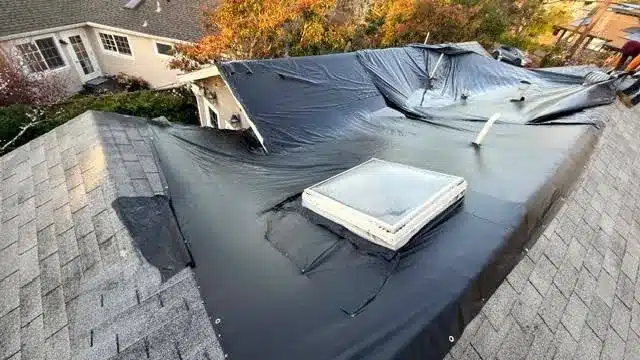
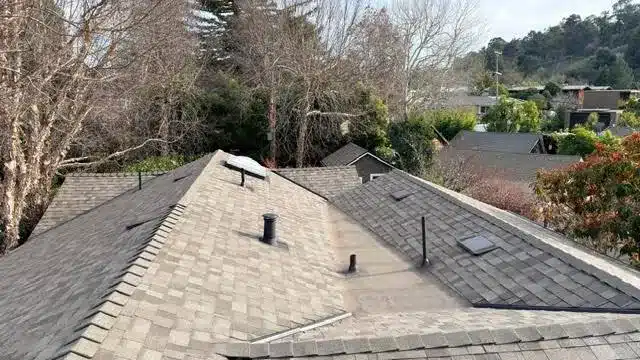
On a steep roof, gravity does half the work — water runs off a tarp onto the shingles below it. On a section under 3:12 there is no such help, so the tarp has to be sized well past the opening on every side and fastened at its edges, not weighted in the middle. A tarp held down by sandbags or a few nails through the field will lift in the first real wind, and every nail hole in the middle of a tarp is a hole water will find.
Enough dry weeks to open the roof up properly and price the real scope, instead of paying for an emergency repair and then paying again. It also preserved the evidence: what was failing was still visible when we got there, rather than buried under a patch.
The deck had failed in places and had to be replaced, and the low-slope sections needed a double layer of underlayment — the detail that stops this recurring under a 3:12 pitch, and the one the original roof did not have. New flashings and a new architectural shingle roof went on the house and the detached backyard studio together.
A tarp is a 90-day temporary shield. Our engineering team provides the full technical scope for a permanent, NDL-warranted repair, and we work with your adjuster to return your property to 100% operational status. If a tarp has already failed on your roof, here is what to do next and how to protect the claim.
Don't let a small leak become a total loss. Our crews are currently active across the South Bay — call now for rapid-response tarping and mitigation.