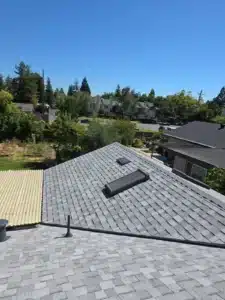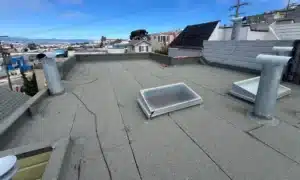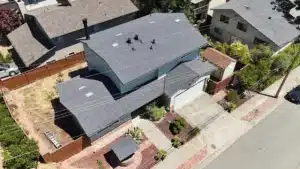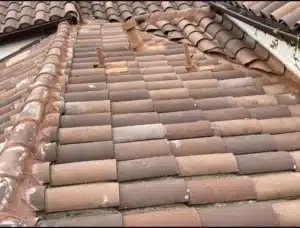
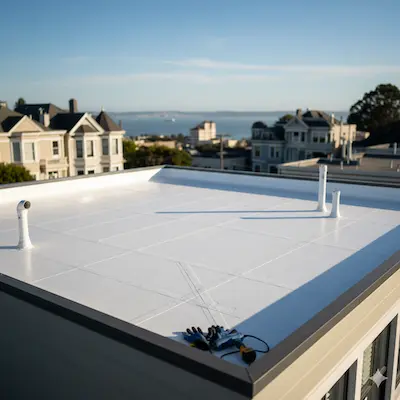
San Francisco Transformation: How We Solved a Decades-Old Flat Roof Issue in San Francisco
San Francisco’s iconic homes have character, charm, and a surprising number of roof problems. When we took on the full TPO replacement at a 2-story San Francisco residence, we inherited a decades-old challenge: two previous emergency patch repairs had created a false sense of temporary security that masked a fundamental problem with the entire roof system. What we discovered during removal—and how we solved it permanently—demonstrates why full replacement trumps endless patching when dealing with aging flat roofs in San Francisco’s fog-prone climate. If you are comparing manufacturers, our overview of commercial roofing products and brands explains the differences.
The Problem: Why Patches Fail on San Francisco’s Flat Roofs
San Francisco’s famous fog and marine layer create a unique roofing challenge. Moisture accumulates underneath flat roof membranes, especially when previous repairs have disturbed the original material. This homeowner’s roof told the story of gradual failure masked by temporary fixes:
First Patch (8 years ago): Leak near a roof vent. The contractor patched with roofing cement and a small membrane section. Cost: $600. This solution worked for 4 years.
Second Patch (4 years ago): Leak appeared 2 feet from the first patch. This time the contractor used a larger patch, suggesting the underlying membrane was deteriorating. Cost: $900. This solution lasted 2 years before moisture returned.
The Third Leak (Current Crisis): Water began seeping near the southwest corner, causing staining in an upstairs bedroom. The patch had failed again, and the homeowner finally accepted what we had been recommending: the entire roof membrane had reached end-of-life.
This pattern is tragically common in San Francisco. Here’s why patches fail:
- Membrane Degradation: After 20+ years, the original membrane loses flexibility and develops micro-cracks. A patch applied over degraded material is like putting a band-aid on concrete—it won’t flex with seasonal temperature changes.
- Seam Vulnerability: Each patch creates new seams. San Francisco’s moisture-laden air constantly tests these seams, and the original membrane around the patch is still aging and weakening.
- Substrate Damage: By the time you see water inside the home, it has likely already entered the roof deck. The wood underneath becomes water-damaged, soft, and vulnerable to mold and deterioration.
- Expanding Problem Zones: Water seeks the path of least resistance. After a patch succeeds in blocking one route, water often finds an adjacent weak point. This is why second and third leaks appear nearby—the entire system is failing, not just one location.
Understanding TPO: The Material We Selected
For this San Francisco property, we recommended a complete TPO (thermoplastic polyolefin) replacement rather than other options like EPDM rubber or built-up asphalt. Here’s why TPO made sense for this specific situation:
What Is TPO?
TPO is a single-membrane roofing system made from a blend of rubber, plastic, and other compounds. It’s manufactured in large rolls (typically 6 feet wide, up to 100 feet long) and installed in a monolithic layer across the entire roof. The key feature is heat-welding: instead of gluing seams (which fail over time), TPO seams are heat-welded using a specialized tool that fuses the two edges at the molecular level, creating a seam stronger than the base material itself.
Why TPO for San Francisco?
Several factors made TPO the right choice:
- Reflectivity: TPO is naturally white/light-colored, reflecting 70-75% of solar radiation. San Francisco’s summer heat isn’t extreme, but light-colored roofs minimize thermal stress on the membrane, extending lifespan.
- Seam Integrity: Heat-welded seams provide superior performance in marine moisture environments compared to adhesive or mechanically fastened systems. San Francisco’s fog creates constant moisture vapor pressure beneath the membrane—heat-welded seams resist this stress.
- Installation Speed: Unlike built-up asphalt systems requiring torch work (hazardous on older homes), TPO is mechanically fastened and heat-welded—a faster, safer process that minimizes disruption.
- Longevity: When properly installed, TPO delivers 25-30 year service life in Bay Area climates. The heat-welded seams age better than adhesive systems.
Comparison: Why Not Patch Again?
Before proposing a $12,000 full replacement, we owed the homeowner an honest analysis of the patch alternative. Here’s what we presented:
Cost-Over-Time Comparison:
- Patch Now Scenario: $1,200 patch today + $1,200 patch in 2 years + $1,200 patch in 4 years + eventual full replacement in 6-8 years = $4,600 in interim costs + full $12,000 replacement = $16,600 total investment over 8 years
- Full Replacement Now: $12,000 upfront + no additional costs for 25-30 years = $12,000 total investment, with roof protection guaranteed through 2050+
The math was clear: patching was a short-term expense that delayed the inevitable while costing more in the long run. Moreover, patching meant continued risk of interior water damage, which carries its own costs in mold remediation and structural repairs.
The Installation Process: Sealing a San Francisco Home
TPO installation looks straightforward from ground level, but the details determine success. Here’s how our team transformed this San Francisco home:
Day 1: Removal and Assessment
We removed the old single-ply membrane and existing flashing. Upon deck exposure, we found the suspected substrate damage: approximately 12% of the roof deck showed water staining and soft spots, particularly around the southwest corner where leaks had been recurring. We replaced damaged decking sections with new CDX plywood, properly fastened.
Day 2: Underlayment and Fastening Preparation
We installed a high-quality synthetic underlayment (not felt) that provides vapor management—critical for San Francisco’s marine layer. The underlayment allows moisture vapor trapped under the membrane to escape slowly while preventing bulk water intrusion. This detail prevents the mold growth and wood rot that destroy roofs in fog-prone climates.
Day 3: TPO Membrane Installation
Our team rolled out TPO membrane in a monolithic layer, mechanically fastening it at specific intervals (6 inches along seams, 12 inches in field) using corrosion-resistant fasteners and square washers. Each fastener must be placed precisely—over-driven fasteners can puncture the membrane, while under-driven fasteners won’t provide secure attachment. This is where experience matters.
Day 4: Heat-Welding Seams
This is the critical step that separates premium TPO installation from amateur work. Our technician used a specialized heat gun to fuse seam edges at approximately 600°F, creating a monolithic bond. The process requires:
- Proper surface preparation (cleaning to remove dust)
- Correct gun temperature and angle
- Appropriate travel speed (too fast = poor bond, too slow = overheating)
- Post-weld inspection and testing
Each seam was inspected using a probe that detects weaknesses before they become problems. This is why seam integrity is so critical—a failed seam can allow moisture intrusion despite the surrounding membrane being intact.
Day 5: Flashing and Penetration Integration
All roof penetrations (2 plumbing vents, 1 roof vent) received new metal flashing that integrates seamlessly with the TPO membrane. The TPO extends 6 inches up each flashing boot, ensuring water cannot run behind the membrane. Each penetration seam was heat-welded rather than glued, for the same reasons we chose heat-welded base seams.
Day 6: Edge Termination and Inspection
TPO doesn’t naturally adhere to edge parapets and trim boards, so we installed termination strips (usually aluminum) that secure the membrane edge and prevent lifting in wind. The homeowner’s south-facing edge is exposed to wind pressure during storms, so this detail is critical for San Francisco conditions.
San Francisco’s Fog and Moisture: The Climate Challenge
San Francisco’s marine layer creates a unique roofing environment that most contractors elsewhere don’t face:
Constant Moisture Vapor Pressure: The cool Pacific keeps surface temperatures low, but fog and humidity create a moisture-laden air mass that constantly tries to diffuse through the roof assembly. Traditional built-up roofs trap this moisture, leading to substrate rot. TPO’s single-membrane design with proper underlayment allows slow vapor migration without bulk water intrusion.
Temperature Differentials: Morning temperatures might be 55°F in fog, afternoon temperatures 70°F in sun. These 15°F swings stress membranes through expansion and contraction. TPO’s flexibility handles these swings better than brittle asphalt, which can crack in cool conditions.
Wind and Exposure: Fog means fewer sunny days to cure roofing cement, but it also means consistent wind from the Pacific. The San Francisco location, at a higher elevation, experiences higher wind loads. TPO’s mechanical fastening and heat-welded seams resist wind uplift better than systems relying solely on adhesive.
Seam Welding: The Real Protection
Most roofing failures occur at seams. For a 3,200 sq. ft. roof, there are typically 300-400 linear feet of seams. Each seam is a potential failure point. Here’s why heat-welding matters in San Francisco:
Adhesive Vs. Heat-Welded Seams: Adhesive-based systems (common with EPDM) rely on roofing cement that remains tacky and flexible. Over 10-20 years, this adhesive hardens and loses flexibility, allowing the seam to separate. San Francisco’s constant moisture vapor pressure accelerates this degradation.
Heat-Welded Advantage: By fusing the membrane material at molecular level, heat-welded seams don’t degrade like adhesive. The seam becomes stronger than the surrounding material—if you pull hard on a properly heat-welded TPO seam, it will tear in the field membrane rather than at the seam.
Inspection and Testing: We test every heat-weld using a specialized probe that confirms complete fusion. A failed weld is identified and repaired immediately—before moisture can exploit it.
What We Discovered During Removal
The substrate inspection revealed why this roof had been leaking:
- Water saturation in decking: Approximately 15% of the ½-inch CDX plywood showed water staining consistent with slow leaks over years
- Mold growth: We found minor mold colonies (white/black staining) in corner areas, indicating trapped moisture beneath the old membrane
- Failed previous repairs: Both patch locations showed adhesive failure—the roofing cement had hardened and lost adhesion to the old membrane
- Membrane brittleness: The old membrane was brittle and cracking even where not patched, confirming end-of-life degradation
This discovery reinforced why patching was doomed to fail. The underlying problem wasn’t isolated—it was systemic degradation of an aging roof system.
Warranty and Long-Term Protection
The TPO system comes with multiple warranties:
- Material Warranty (10 years): TPO manufacturer covers material defects, with pro-rata coverage extending to 20 years
- Seam Warranty (10 years): If any heat-welded seam fails due to improper installation, the manufacturer and our company cover the repair
- Workmanship Guarantee (5 years): Lifetime Roofing guarantees our installation labor against defects
Beyond warranty, we recommended annual inspections for the first three years to ensure continued performance, and a regular maintenance plan focused on keeping debris cleared and ensuring drains function properly.
Energy Efficiency and Cool Roof Benefits
While San Francisco doesn’t experience extreme summer heat like other Bay Area cities, the light-colored TPO membrane provides measurable benefits:
Solar Reflectance: White TPO reflects 75% of solar radiation, keeping the attic cooler. Even modest attic cooling translates to reduced AC load on hot days.
Estimated Energy Impact: For this 3,200 sq. ft. home, we estimate a 5-7% reduction in cooling costs on hot days. Over a 25-year roof life, this represents approximately $3,000-$4,500 in energy savings.
Timeline and Disruption Minimization
The homeowners were concerned about disruption during the project. We completed the installation in 6 days:
- Day 1: Removal and deck assessment
- Day 2: Underlayment installation
- Day 3: TPO membrane rolling and fastening
- Day 4: Heat-weld seam completion
- Day 5: Flashing and penetration integration
- Day 6: Edge termination and final inspection
Work occurred Monday through Friday, 7:30 AM to 4:00 PM, allowing normal evening use of the home. We maintained safe work practices and cleaned daily, ensuring minimal disruption to the neighborhood.
The Investment: Understanding TPO Costs
For a 3,200 sq. ft. flat roof in San Francisco with TPO replacement:
- TPO membrane (premium grade): $3,200-$4,000
- Installation labor (heat-welded seams): $4,800-$5,400
- Flashing and penetrations: $1,200-$1,600
- Deck repairs (substrate damage): $800-$1,600
- Total project range: $10,000-$12,600
This represents a significant investment, but when compared against the patch-and-wait alternative, the full replacement delivers better long-term value and eliminates the risk of interior water damage.
Maintenance for 25-Year Roof Life
To maximize the lifespan of this new TPO roof, we recommended:
- Annual Inspections: Check for debris accumulation, drain function, and any visible membrane damage
- Quarterly Drain Cleaning: Ensure interior roof drains remain clear—clogged drains create ponding and accelerate failure
- Avoid Foot Traffic: While TPO is durable, unnecessary foot traffic can cause punctures
- Tree Trimming: Keep overhanging branches trimmed to prevent debris accumulation and puncture hazards
Moving Forward: No More Leak Worries
The homeowners in San Francisco can now enjoy their San Francisco home without the constant anxiety of roof leaks. The full TPO replacement—with heat-welded seams, proper flashing, and substrate repair—provides 25-30 years of protection against the fog, wind, and moisture that define San Francisco’s climate.
If you own a San Francisco property with a flat roof that’s developed leaks or shows its age, the pattern we saw at this San Francisco home is likely familiar: patching buys time but never solves the fundamental problem. A proper full replacement, done right, is the permanent solution. If the leaks are still local, start with flat roof repair rather than a full replacement — it is worth knowing which one you are actually looking at.
Let Us Transform Your Roof
Lifetime Roofing has completed over 500 residential and commercial roofing projects throughout the Bay Area, with extensive experience in San Francisco’s unique climate and architectural challenges. We’re Owens Corning Platinum Preferred Contractors and CertainTeed Certified, with 16+ years of hands-on experience in roofing that lasts.
Schedule your free roof inspection: (408) 685-2177
We’ll assess your roof’s condition, explain exactly what we find, and provide a detailed estimate with no pressure or hidden costs. For San Francisco properties specifically, we understand the fog, the moisture, and the unique challenges your home faces.
Learn more about our commercial roofing services or explore our emergency roof solutions.
Related San Francisco flat-roof reading: San Francisco roofing.
Gina K. writes about Bay Area roofing for Lifetime Roofing & Renovation, drawing on the team's 16+ years of experience roofing homes across Silicon Valley.