
Commercial roofing is a different trade from residential — different systems, different warranties, different insurance requirements. Here is what to verify before a contractor sets foot on your building.
Start with the same licence check you would run on any roofer, then add the three things commercial work requires and residential does not: proof of insurance that names your entity, demonstrated experience with your specific membrane, and a written plan for keeping the building operating while the work happens. California licensing runs through the Contractors State License Board, and roofing requires the C-39 classification — that part is identical. What changes is the exposure: a commercial reroof involves tenants, occupied floors, roof-mounted equipment and a building envelope that someone else's business depends on.
Licence to verify — CA #1090028 (C-39), active
Systems we install and restore — TPO, EPDM, PVC, modified bitumen
Emergency response — 24/7 for active commercial leaks
Operating in the Bay Area since — 2010
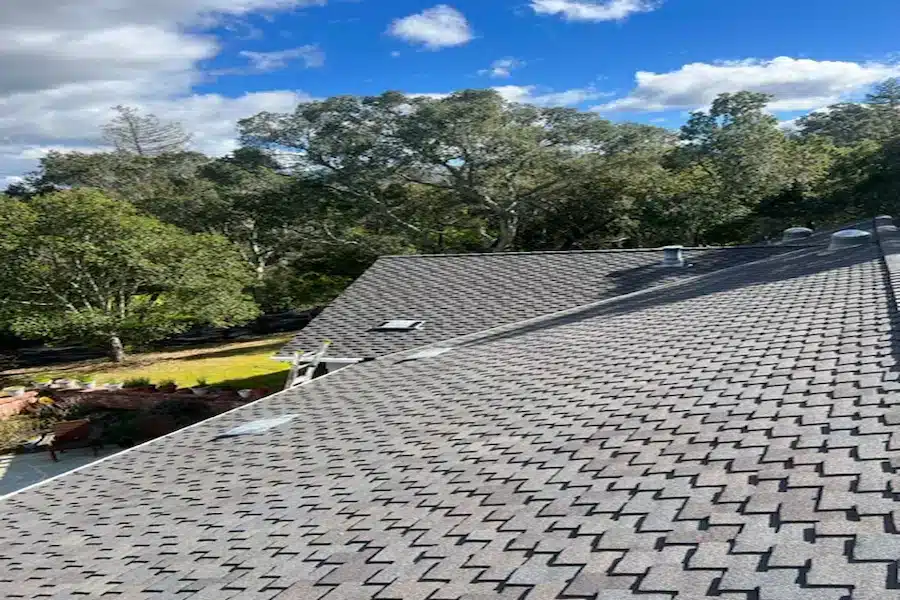
If a contractor's portfolio is all pitched shingle roofs, they are learning your membrane on your building. These are the practical differences.
| Residential | Commercial & industrial | |
|---|---|---|
| Roof shape | Pitched, water sheds fast | Flat or low-slope — water sits, so seams and drainage decide everything |
| Materials | Asphalt shingle, tile, metal | Single-ply membrane (TPO, EPDM, PVC), modified bitumen, built-up, coatings |
| How it fails | Lifted or missing shingles, flashing | Seam separation, ponding water, failed penetration details around HVAC |
| Rooftop equipment | Rare | HVAC units, ducts, conduit, solar — every penetration is a potential leak |
| Disruption | A family for a few days | Tenants and operations — phasing and access planning are part of the job |
| Warranty | Manufacturer system warranty on the assembly | Manufacturer NDL, material-only, or contractor workmanship — not the same thing |
There is no single best commercial membrane — the right answer depends on your deck, your rooftop equipment, your exposure and whether the existing roof can be restored rather than replaced. A contractor who recommends the same system on every building is selling inventory, not solving your problem. Ask why this system for this roof, and expect an answer about slope, drainage, foot traffic and what is already down there.
| System | Suits | Watch for |
|---|---|---|
| TPO | Reflective single-ply for warehouses, retail and offices where cooling load matters | Seam quality is everything — it is heat-welded, so installer skill shows up years later |
| EPDM | Long-serving rubber membrane, forgiving on irregular roofs | Dark surface absorbs heat unless a reflective coating is specified |
| PVC | Restaurants and any roof exposed to grease, oils or chemical exhaust | Higher material cost; specify it where the exposure actually justifies it |
| Modified bitumen | Smaller roofs, decks with heavy foot traffic | Multi-ply detail work at penetrations is where failures start |
| Coatings & restoration | A structurally sound roof with life left — extends service without a tear-off | Only valid if the substrate is dry; coating over trapped moisture buys nothing |
Before you approve a full replacement, ask whether restoration is viable. A roof with intact insulation and a sound deck can often be recoated instead of torn off, at a fraction of the cost and disruption. The honest test is a moisture survey — if the substrate is wet, restoration is the wrong call and any contractor who offers it anyway is guessing. A commercial roof inspection is what tells you which situation you are in.
Emergency response has two phases, and they are different jobs: stop the water today, diagnose and repair properly afterwards. Anyone who arrives during an active leak and proposes a full replacement on the spot has skipped the diagnosis. The first visit should stabilise the building — temporary membrane patching or tarping over the entry point, water diverted away from inventory and electrical — and document what was found. The permanent repair follows once the roof is dry enough to work on properly.
What is the callout window, what does the emergency visit cost, and does that cost credit toward the permanent repair? Get it in writing even at 2am — a text message counts.
Photograph the interior damage, the ceiling entry point and any affected stock or equipment before anything is cleaned up. If you are filing an insurance claim, that evidence is far harder to reconstruct later.
Pick the service or the location and go straight to the detail.
Coating over saturated insulation seals the water in. If nobody checked whether the substrate is dry, the recommendation is a guess with your building as the test.
Manufacturer NDL, material-only and contractor workmanship warranties cover very different things. Ask which one, who issues it, what voids it, and whether it survives a change of ownership.
You should receive a COI naming your entity, with general liability and workers' compensation current. On commercial property this is basic, not an imposition.
A number quoted off satellite imagery has priced the area, not the roof. Penetrations, drainage, existing layers and equipment are what drive commercial cost.
Access, staging, hours, odour and noise all affect tenants. A contractor who has not raised phasing has not thought about the building as an occupied asset.
California energy standards can dictate reflectivity on a commercial reroof. If it has not come up, find out whether it applies before the inspector tells you it did.
Licensed, insured and locally based — not a national outfit subcontracting your building to whoever is available.
It depends far more on the failure than on the square footage. A handful of failed seams or a leaking HVAC curb is a contained repair; widespread ponding and saturated insulation is a different scale of work. Any figure quoted before someone has been on the roof is a placeholder — ask for the number after the inspection, itemised by what is actually being done.
Often, yes. If the deck is sound and the insulation is dry, targeted repair or a restoration coating can add years without a tear-off. The deciding factor is moisture in the substrate, which is why a proper commercial roof inspection comes before any recommendation. See also repair vs. replacement.
Yes. For active leaks we stabilise first — stopping water entry and protecting stock, equipment and electrical — then return for the permanent repair once conditions allow. Call (408) 685-2177, or see 24/7 emergency commercial roofing.
Twice a year is the common standard — before and after the wet season — plus after any major storm or rooftop equipment work. Flat roofs fail quietly: by the time a leak shows inside, water has usually been tracking through the assembly for a while. Scheduled inspection is what turns a replacement into a repair.
Possibly. California's energy standards can require a minimum reflectivity on commercial reroofs depending on climate zone, roof slope and the assembly involved. It is worth resolving before the work is scoped rather than at inspection — see Title 24 cool roofing.
Yes — including phased work across occupied buildings, scheduled maintenance programmes, and documentation suitable for owners and boards. Tell us how many roofs and we will scope it as a portfolio rather than a series of one-off jobs.
San Jose and the wider Bay Area including Sunnyvale, Santa Clara, San Mateo County, Alameda County, Contra Costa County and San Francisco.
Licence CA #1090028 (C-39), insured, Bay Area based since 2010. We inspect first and scope second — itemised, in writing.