Metal roofing’s main advantages are lifespan, light weight, fire resistance and reflective finishes that meet California’s cool-roof rules. A standing-seam roof typically lasts 40–70 years, roughly twice as long as asphalt shingles. The trade-off is price: installed in the Bay Area, standing seam runs about $18–$35 per square foot, compared with about $8–$15 for architectural shingles. Metal pays off best when you plan to stay in the home for a long time, live in a fire hazard zone, or want a roof that will outlast a solar array.
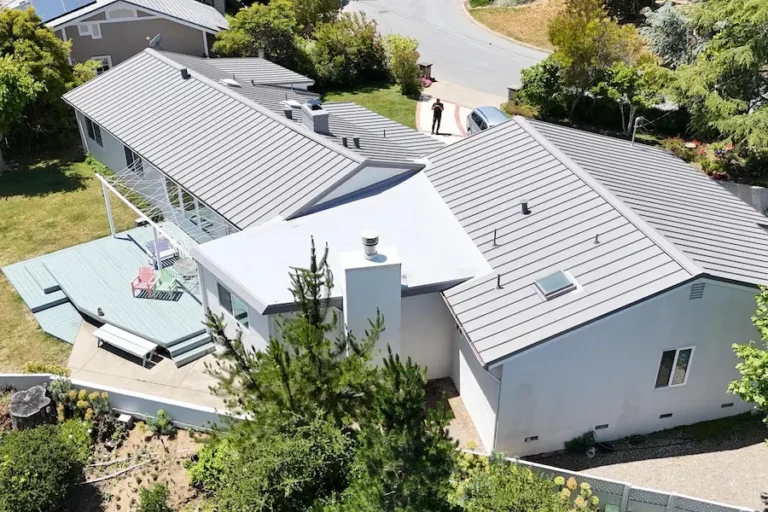
This guide covers the types of metal roofing, what each advantage actually amounts to, where the common claims go too far, and how the cost compares over time. The photo at the top is a standing-seam re-roof we completed in San Mateo.
Types of metal roofing for homes
| Type | What it is | Typical lifespan | Best for |
|---|---|---|---|
| Standing-seam steel | Long vertical panels with raised seams and concealed fasteners, usually with a PVDF (Kynar 500-type) painted finish | 40–70 years | Most Bay Area homes choosing metal |
| Standing-seam aluminum | Same profile in aluminum, which doesn’t rust | 40–70 years | Coastal homes exposed to salt air |
| Stone-coated steel | Steel panels with a granular coating shaped to look like shingles, tile or shake | 40–50 years | Homes that want the look of shingle or tile at lighter weight |
| Exposed-fastener (corrugated or ribbed) | Panels screwed through the face, with rubber-washer fasteners | 20–40 years; fasteners need periodic attention | Outbuildings, barns and some modern designs |
Standing seam is the residential standard for a reason: the fasteners are hidden under the seam, so there are no hundreds of screw holes to maintain. Exposed-fastener panels cost less, but their washers dry out in the California sun and need replacing over the life of the roof.
The real advantages of a metal roof
1. It lasts two to three times as long as shingles
A well-installed standing-seam roof with a quality painted finish typically lasts 40–70 years. Architectural asphalt shingles typically last 20–30 years in California’s sun. For many homeowners, that means one metal roof instead of two or three shingle roofs over the time they own the house.
2. It’s light, so no structural upgrades
Metal is one of the lightest roofing options, lighter than asphalt shingles per square foot and far lighter than tile. That matters for older framing and in earthquake country, since a lighter roof adds less load to the walls below it during shaking. Switching from shingles to metal almost never needs structural work, while switching to tile often does.
3. Strong fire performance
Metal panels don’t burn, and metal roof systems carry Class A fire ratings as tested assemblies (panel plus the specified underlayment). That makes metal one of the strongest choices in California’s Fire Hazard Severity Zones and Wildland-Urban Interface areas, where the building code requires a fire-rated roof assembly. The details still matter: ridge and eave closures, ember-resistant vents and clean gutters are part of a fire-resistant roof. When you compare quotes, ask for the Class A assembly listing, not just the panel.
4. Reflective finishes that meet Title 24
If more than half of a steep-slope roof is replaced in Climate Zones 4 and 8–15, which includes San Jose and most of Santa Clara County, California’s Energy Code requires a cool roof. That means an aged solar reflectance of at least 0.20 with thermal emittance of at least 0.75, or an aged SRI of at least 16, unless an exception applies. Many painted metal finishes clear that bar easily, and light colors clear it by a wide margin. As with any material, the specific color needs a Cool Roof Rating Council (CRRC) listing. See our cool roofing and Title 24 guide and our Title 24 compliance explainer.
5. Very little maintenance
Standing seam needs an occasional check of flashings and penetrations, clear gutters and valleys, and a look after major storms. There are no granules to shed and no individual shingles to blow off.
6. The best base for solar
Solar racking can clamp directly onto standing seams, so panels can be mounted without drilling through the roof. And because the roof will outlast the panels, you’re unlikely to pay to remove and reinstall the array for a re-roof partway through its life.
7. Energy savings, with realistic expectations
A reflective metal roof keeps the roof surface and attic cooler than a dark roof, which lowers air-conditioning load. How much you save depends on your attic: the effect is biggest when HVAC ducts run through a hot attic and smallest in a well-insulated attic with no ducts. We don’t quote a percentage savings figure, because it varies too much from house to house to be honest about.
Metal roofing myths and half-truths
“Metal roofs are loud in the rain”
Not when they’re installed over solid decking with underlayment and an insulated attic, which is how residential standing seam is installed. The drumming people remember comes from panels over open framing, as on a barn.
“Metal roofs attract lightning”
They don’t. Lightning strikes based on height and location, not roofing material. If lightning does hit a building, a metal roof is non-combustible.
“Metal roofs rust”
Modern steel roofing panels are metallic-coated (galvanized or aluminum-zinc) and then painted, and aluminum doesn’t rust at all. Cut edges and scratches need proper treatment during installation. For homes within sight of the ocean, aluminum is the safer choice.
“Hail will dent it”
Large hail can dent thinner panels, but hail big enough to do that is rare in the Bay Area. It’s a bigger concern in other states than here.
“Metal roofs make the house hotter”
The opposite, if you choose a reflective finish. A light or cool-rated metal roof reflects much of the sun’s energy and releases absorbed heat quickly after sunset.
What does a metal roof cost in the Bay Area?
Standing-seam metal typically costs about $18–$35 per square foot installed in the Bay Area, including tear-off, underlayment and permit. For about 2,000 square feet of roof, that’s roughly $36,000–$70,000. What moves the price:
- Roof shape: hips, valleys, dormers and penetrations each need custom flashing, and steep pitches take longer to install safely.
- Material and gauge: aluminum costs more than steel, and heavier-gauge panels cost more than thin ones.
- Finish: PVDF (Kynar 500-type) paint costs more than basic polyester finishes and holds its color far longer.
- Tear-off and deck repair: more layers to remove, or damaged sheathing, add cost.
- Fire-zone requirements: ember-resistant vents and closures add a little.
Stone-coated steel and exposed-fastener systems are quoted per project. For comparison with other materials, see our California roofing materials comparison and asphalt vs. tile vs. metal.

Metal vs. asphalt: the long-term math
Metal costs roughly two to three times as much as asphalt up front, so the fair comparison is cost per year of service. Using Bay Area installed prices for about 2,000 square feet of roof:
| Architectural asphalt | Standing-seam metal | |
|---|---|---|
| Installed cost | $16,000–$30,000 | $36,000–$70,000 |
| Realistic lifespan | 20–30 years | 40–70 years |
| Cost per year of service (midpoints) | About $920 per year ($23,000 over 25 years) | About $960 per year ($53,000 over 55 years) |
Per year of service, the two come out close. Metal’s real financial advantage is avoiding a second tear-off, disposal and permit, plus a solar removal and reinstallation if you have panels. That advantage only shows up if you stay in the home long enough to need that second shingle roof. If you’re likely to sell within 10 years, asphalt is usually the better financial choice. If you plan to stay 25 years or more, or you’re in a fire zone, metal makes a strong case.
Bay Area considerations
- Coastal homes (San Francisco, the Peninsula coast, Santa Cruz): salt air corrodes steel faster, so aluminum is the safer choice within sight of the ocean.
- Hillside and foothill homes (Los Gatos, Saratoga, the Santa Cruz Mountains, the Oakland and Berkeley hills): this is where metal’s fire performance matters most. Check whether your address is in a Fire Hazard Severity Zone.
- Climate Zone 4 (San Jose and most of Santa Clara County): a full re-roof must meet the cool-roof rule unless an exception applies, so pick a CRRC-rated finish.
- HOAs and historic districts: some restrict visible metal. Stone-coated steel is sometimes accepted where standing seam isn’t, so check before you choose.
Warranties
Metal roofs usually carry two separate warranties. The manufacturer’s finish warranty covers fading and chalking of the paint, and PVDF finishes carry the longest terms. The contractor’s workmanship warranty covers the installation. Read both: finish warranties are often prorated, and they usually require proper installation and ventilation to stay valid. Ask any contractor which terms apply to the exact panel and finish they’re quoting.
Is metal roofing right for your home?
- Metal is a strong fit if you plan to stay 20+ years, you’re in a fire hazard zone, you’re adding or keeping solar, or your framing can’t take extra weight.
- Asphalt is usually the better value if you may sell within about 10 years, or your budget is fixed and the difference would come out of other repairs.
- Consider tile instead if your home is Spanish or Mediterranean style and already framed for tile. Inspect the underlayment first, because a lift-and-relay may be all it needs.
Frequently asked questions
How long does a metal roof last in California?
A standing-seam metal roof with a quality painted finish typically lasts 40–70 years. Exposed-fastener metal roofs last less, often 20–40 years, and their fasteners need periodic maintenance.
How much does a metal roof cost in the Bay Area?
Standing seam typically runs about $18–$35 per square foot installed, or roughly $36,000–$70,000 for 2,000 square feet of roof. Complex roofs, aluminum panels and premium finishes sit at the top of that range.
Does a metal roof meet Title 24?
Many painted metal finishes do. For steep-slope re-roofs in Climate Zones 4 and 8–15, the requirement is an aged solar reflectance of 0.20 with emittance of 0.75, or an aged SRI of 16. Confirm that your specific color is CRRC-listed.
Is a metal roof louder than shingles?
Not when it’s installed over solid decking with underlayment and an insulated attic. Rain on a residential standing-seam roof sounds much like rain on any other roof.
Is metal roofing worth it?
It depends on how long you’ll own the home. Per year of service, metal and asphalt cost about the same. Metal comes out ahead if you stay long enough to avoid a second re-roof, or if fire resistance or solar are priorities.
Talk to us about metal
We’ll check your roof’s framing, pitch, climate zone and fire zone, and give you a side-by-side quote for metal and shingle so you can compare. Call (408) 685-2177 or request a free estimate. Learn more about our metal roofing services.
Gina K. writes about Bay Area roofing for Lifetime Roofing & Renovation, drawing on the team's 16+ years of experience and 1,000+ completed roofs across Silicon Valley.