Our Most Trusted Commercial Roofing Products & Brands
Choosing the right roofing material for a commercial property is one of the most important decisions a building owner or manager makes. The material you select affects energy costs, maintenance requirements, lifespan, warranty protection, and long-term asset value. At Lifetime Roofing & Renovation, we’ve installed over 500 roofing projects across commercial buildings in the Bay Area, and we’ve learned which products deliver real-world performance year after year. We specify and install products from industry leaders like GAF, Carlisle SynTec, and others — chosen based on building use, climate exposure, budget, and performance requirements.
Why Product Selection Matters for Commercial Roofing
Unlike residential roofing, commercial roofing choices carry higher stakes. A commercial roof failure impacts tenant operations, can disrupt businesses for weeks, and risks significant structural damage. The product you choose determines:
- Durability in Bay Area climate: Our region experiences moderate rainfall, rare hail, UV exposure, and thermal cycling that ages roofing materials. Some products handle this better than others.
- Energy efficiency: Cool-roof products with high solar reflectance (high R-value) can reduce HVAC costs by 10-25% annually on large buildings.
- Installation timeline: Some products install faster than others, reducing labor costs and building disruption.
- Maintenance burden: Some roofs require annual inspections and maintenance; others are nearly maintenance-free.
- Warranty depth: Manufacturer warranties range from 10-30 years and come with different conditions and coverage levels.
- Future repair parts availability: If you need repairs in 10 years, will your product still be manufactured? Can you source compatible materials?
We guide clients through these tradeoffs based on specific building characteristics and risk tolerance.
GAF Commercial Roofing Systems
GAF is North America’s largest roofing manufacturer, and we’ve installed their commercial products on dozens of projects. They excel in three product categories:
TPO (Thermoplastic Polyolefin)
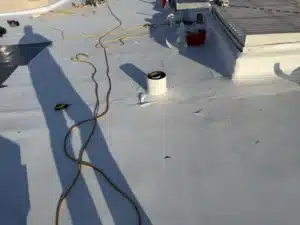
GAF’s TPO systems are single-ply membranes with exceptional durability and energy efficiency. The membrane is one continuous sheet, heat-welded at seams, creating a waterproof barrier with no fasteners penetrating the surface (unlike some competing systems).
- Best for: Warehouses, light manufacturing, logistics centers, cold-storage facilities
- Warranty: 20-30 years depending on system specification
- Energy efficiency: White or light colors reflect 80%+ of solar radiation, reducing cooling costs on large roofs
- Installation: Seams are heat-welded by trained technicians; quality depends on installer certification
- Cost: Mid-range for commercial ($4-7 per sq ft installed, depending on size and complexity)
- Maintenance: Minimal — annual inspection recommended, occasional membrane cleaning
We’ve used GAF TPO on three large warehouse projects in San Jose with excellent results. One client reported a 22% reduction in summer cooling costs after switching from an aged BUR (built-up roof) to GAF TPO.
PVC (Polyvinyl Chloride)
GAF’s PVC systems are single-ply thermoset membranes — thermally rigid and highly resistant to puncture and chemicals. If your building has frequent foot traffic, rooftop equipment, or chemical exposure, PVC is more durable than TPO.
- Best for: Chemical plants, manufacturing, facilities with rooftop equipment, high-traffic roofs, food processing
- Warranty: 20-30 years
- Energy efficiency: White versions reflect 85%+ of solar radiation; slightly better than TPO for reflectance
- Installation: Seams are chemically welded; like TPO, quality depends on certified installer
- Cost: Slightly higher than TPO ($5-8 per sq ft installed)
- Maintenance: Very minimal; PVC is extremely durable and resists UV aging
- Lifespan: Often exceeds 30 years with minimal intervention
We’ve installed GAF PVC on a electronics manufacturing facility that experiences aggressive chemical cleaning. Seven years in, zero membrane issues and no additional maintenance beyond annual inspections.
EverGuard TPO/PVC Hybrid
GAF’s EverGuard combines TPO’s ease of installation with PVC’s durability. It’s an excellent mid-ground choice for clients balancing budget and long-term performance.
- Best for: Office buildings, retail centers, mixed-use properties, budget-conscious projects requiring durability
- Warranty: 25-30 years
- Cost: Slightly less than pure PVC, competitive with TPO ($4.50-7.50 per sq ft installed)
- Performance: Combines TPO’s installation flexibility with PVC’s puncture resistance and UV stability
Carlisle SynTec Roofing Systems
Carlisle SynTec is a specialist in single-ply roofing and has been a preferred partner for larger commercial projects where maximum durability and warranty protection matter.
EPDM (Ethylene Propylene Diene Monomer)
Though older technology (EPDM was invented in the 1960s), it remains effective for certain applications. Carlisle’s EPDM is a synthetic rubber membrane highly resistant to weather and UV.
- Best for: Agricultural buildings, storage facilities, buildings where extreme durability is needed with minimal budget
- Warranty: 20-25 years (industry standard)
- Cost: Budget-friendly ($3-5 per sq ft installed)
- Lifespan: Often exceeds 30-40 years; EPDM simply doesn’t degrade quickly
- Drawback: Seams use mechanically fastened tape (less elegant than heat-welded seams); requires careful maintenance
- Maintenance: More intensive than TPO/PVC; seams must be inspected regularly
We use Carlisle EPDM for budget-constrained projects where durability is secondary to cost. It works but requires more ongoing attention than newer TPO/PVC systems.
Carlisle Syntec Fleece TPO
A premium TPO variant with built-in reinforcement, offering superior puncture resistance and walkability compared to standard TPO.
- Best for: Buildings with frequent rooftop traffic, HVAC contractors, satellite installers, facilities requiring rooftop maintenance
- Warranty: 25-30 years
- Cost: Premium ($6-9 per sq ft installed)
- Advantage: Doesn’t require walkway protection in high-traffic areas; membrane itself resists puncture
- Energy efficiency: Comparable to standard TPO
Other Trusted Brands We Specify
Firestone (Bridgestone subsidiary)
Firestone specializes in EPDM and has an excellent reputation for durability. We specify Firestone on projects where we know the building will be occupied for 30+ years and the owner values long-term reliability over initial cost.
- Best for: Long-term building assets, heritage buildings, institutional properties
- Warranty: 20-30 years (with optional extended programs)
- Cost: Premium positioning ($5-8 per sq ft installed)
Johns Manville (Berkshire subsidiary)
Johns Manville produces TPO, PVC, and built-up roof systems. Their products are solid mid-market choices with good warranty terms and decent installer networks.
- Best for: Mid-range commercial projects, competitive bidding situations where we need viable alternatives
- Warranty: 20-30 years
- Cost: Competitive ($4-7 per sq ft installed)
Sika/Sikaplan
European manufacturer with premium positioning. Sikaplan PVC is known for exceptional quality and consistency. We specify this for high-profile projects where reputation matters.
- Best for: Premium commercial properties, visible roofs, buildings where aesthetic and performance both matter
- Warranty: 30 years (industry-leading)
- Cost: Premium ($7-10 per sq ft installed)
Comparing Product Categories: TPO vs. PVC vs. EPDM
Here’s a side-by-side comparison to help you understand the tradeoffs:
TPO (Thermoplastic Polyolefin)
- Cost: $$$ (mid-range)
- Durability: Excellent (25-30 year lifespan)
- Energy efficiency: Excellent (white versions 80%+ solar reflectance)
- Installation speed: Fast (heat-welded seams)
- Maintenance: Minimal
- Best for: Warehouses, large open spaces, energy cost–sensitive projects
PVC (Polyvinyl Chloride)
- Cost: $$$$ (premium)
- Durability: Exceptional (30-40+ year potential)
- Energy efficiency: Excellent (white versions 85%+ solar reflectance)
- Installation speed: Moderate (chemical-welded seams, requires skill)
- Maintenance: Very minimal
- Best for: Chemical exposure, high-traffic roofs, maximum durability scenarios
EPDM (Ethylene Propylene Diene Monomer)
- Cost: $$ (budget-friendly)
- Durability: Good to excellent (30-40+ year potential, but less puncture-resistant)
- Energy efficiency: Fair (black versions absorb heat; white EPDM available but less common)
- Installation speed: Moderate (mechanically fastened seams)
- Maintenance: Moderate (seam inspection required)
- Best for: Budget-constrained projects, agricultural buildings, long-term durability value plays
How We Select the Right Product for Your Project
At Lifetime Roofing & Renovation, we follow a structured process:
Step 1: Understand Building Use & Occupancy
A warehouse with minimal foot traffic has different requirements than a rooftop restaurant or equipment-heavy HVAC installation. Occupied buildings benefit from cool roofing (TPO/PVC) for energy savings. High-traffic roofs need durability and puncture resistance (PVC or reinforced TPO).
Step 2: Assess Climate & Exposure
San Jose and the broader Bay Area experience moderate rainfall, seasonal UV exposure, and occasional thermal cycling. All our specified products handle this well. However, coastal properties (salt spray exposure) benefit from PVC’s superior chemical resistance. Inland properties with intense summer sun benefit from TPO’s reflectance properties.
Step 3: Evaluate Budget & Lifecycle Cost
Lowest initial cost isn’t always best value. A warehouse owner considering 30-year building occupancy might choose PVC (higher upfront cost) over TPO because PVC lasts longer and requires less maintenance. The lower lifecycle cost justifies the initial premium.
Step 4: Consider Warranty & Manufacturer Support
We specify products where the manufacturer will stand behind the warranty for the full term. GAF, Carlisle, Firestone, and Sika all have strong track records. We work exclusively with certified installers to ensure warranties are valid.
Step 5: Verify Installer Certification & Training
A product is only as good as its installation. We maintain current certifications for all major brands and ensure our installation teams are trained on proper techniques. This ensures your warranty is valid and performance is optimized.
Warranty Details & What They Actually Cover
Manufacturer warranties vary significantly. Here’s what you need to understand:
Standard Manufacturer Warranty (Typical 20-30 years)
Covers material defects — seam failures, manufacturing flaws, membrane deterioration due to manufacturing issues. Does NOT cover:
- Installation defects (unless the manufacturer-approved installer caused them)
- Weather damage (hail, wind, fallen debris)
- Lack of maintenance
- Changes to building use or conditions
Labor Warranty
We provide our own 10-year labor warranty on all commercial installations. This covers workmanship defects — improper flashing, seam failures due to installation error, and similar issues. This supplements the manufacturer’s material warranty.
Extended Warranty Programs
Most manufacturers offer optional extended warranties (up to 50 years) for an additional cost. These programs often include: – Annual inspections – Enhanced coverage for weather damage – Labor coverage for repairs – Replacement provisions if repairs exceed threshold percentages
Extended warranties typically cost 15-25% of the system cost but can provide valuable peace of mind for long-term building assets.
Installation Requirements & What Goes Into Proper Specification
Each product has specific installation requirements. Shortcuts create failures:
Substrate Preparation
The underlying roof deck must be smooth, dry, and properly sloped. If your existing roof is deteriorated, we often remove it completely and install a new substrate before applying the membrane. This adds cost upfront but ensures the new roof lasts the full warranty period.
Seam Specification & Quality Control
For TPO and PVC systems, seam quality is critical. Heat-welded seams must be inspected with specialized equipment. We use dual-track welding equipment and verify every seam during installation. We typically perform a percentage of non-destructive testing (ASTM D4141) to ensure proper seam strength.
Flashing & Penetrations
Roof penetrations (pipes, vents, skylights) and edges (walls, parapets) are where most leaks originate. We use manufacturer-approved flashings and detail them carefully. This accounts for 20-30% of the labor cost but is essential.
Slope & Drainage
Proper roof slope (minimum 1/8″ per 12′ in most cases) ensures water flows off efficiently. Ponding water accelerates aging and creates leak pathways. We verify slope during design and ensure the contractor maintains it during installation.
Maintenance Requirements by Product Type
After installation, ongoing maintenance affects long-term performance:
TPO Systems
- Annual inspection: Visual inspection for tears, seam issues, or debris accumulation
- Cleaning: Debris removal (leaves, branches) prevents water pooling and accelerated aging
- Repair: Small tears can be patched with TPO patches (DIY-able but best left to professionals)
- Frequency: 1-2 inspections annually, cleaning as needed after storms
PVC Systems
- Annual inspection: Same visual inspection as TPO
- Cleaning: Debris removal beneficial but less critical (PVC ages more slowly)
- Repair: Requires professional repair technicians; PVC patches are more involved
- Frequency: 1 inspection annually; minimal additional maintenance
EPDM Systems
- Annual seam inspection: Critical — seams are mechanically fastened and vulnerable
- Seam treatment: Periodic re-sealing with EPDM tape recommended every 5-10 years
- Cleaning: Debris removal important (EPDM attracts moss/algae growth more than TPO/PVC)
- Frequency: 2 inspections annually, seam maintenance every 5-10 years
Cost Tiers Explained
Economy Tier ($3-5 per sq ft installed)
EPDM with basic installation. Best for temporary roofs, agricultural buildings, or extremely cost-conscious projects. Expect 25-30 year lifespan with maintenance.
Mid-Market Tier ($5-7 per sq ft installed)
Standard TPO or comparable products. Appropriate for most commercial buildings. Good balance of cost, durability, and warranty protection.
Premium Tier ($7-10+ per sq ft installed)
PVC, reinforced TPO, or extended warranty programs. Best for long-term building assets, high-visibility projects, or maximum durability requirements.
Factors That Increase Cost:
- Roof complexity (many penetrations, skylights, edges)
- Steep pitch or unusual slope
- Existing roof removal and substrate repair
- Flashing upgrades (high-quality metal, custom details)
- Extended warranty programs
- Expedited installation timelines
Our Commitment to Product Quality & Installer Certification
We’re Owens Corning Platinum Preferred and CertainTeed Certified, meaning we’ve met rigorous training and quality standards for commercial roofing. This certification matters because:
- Manufacturer support: We have direct access to product engineers and technical support
- Warranty protection: Our certification ensures your warranty is valid
- Installation training: Our teams are trained on latest techniques and equipment
- Quality oversight: Regular audits ensure we meet quality standards
When you hire Lifetime Roofing, you’re not just getting a roof — you’re getting a manufacturer-backed guarantee that the job is done right.
Let’s Choose the Right Roof for Your Building
Roofing product selection should be a collaborative decision based on your building’s specific needs, your budget, and your long-term asset strategy. We’ve installed these products on commercial buildings across the Bay Area and know which ones deliver real performance.
Call us at (408) 685-2177 to discuss your commercial roofing project. We’ll assess your building, present product options with honest tradeoff analysis, and help you choose the system that’s right for your situation.
Ready to explore roofing options for your building? Visit our commercial roofing services page or learn more about our roof replacement process.
Lifetime Roofing & Renovation — 16+ years of experience, 500+ commercial and residential projects, Owens Corning Platinum Preferred, CertainTeed Certified.
Gina K. writes about Bay Area roofing for Lifetime Roofing & Renovation, drawing on the team's 16+ years of experience and 1,000+ completed roofs across Silicon Valley.