
Emergency Roofing · Bay Area
If a tarp failed and water is now inside your house, the first job is stopping the water and recording the damage — in that order. Everything about who pays comes after, and it goes better when you have photographs and dates.
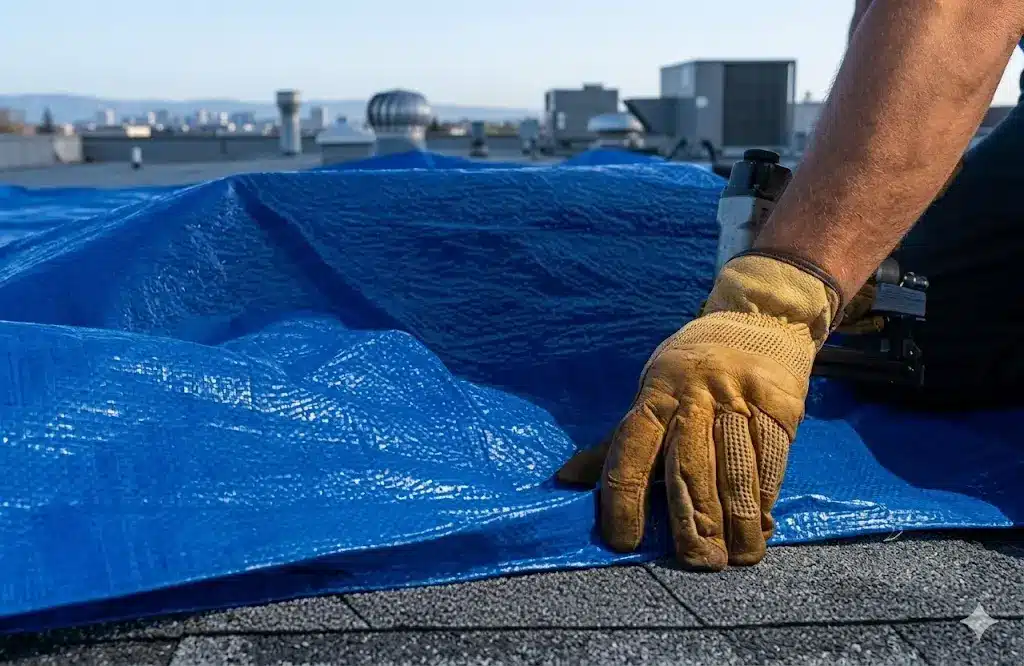
Get the water stopped first, then document everything before anything is cleaned up or repaired. Photograph the failed tarp in place, the interior damage and the dates, put the contractor on notice in writing rather than by phone, and get a second roofer to inspect and write up what actually failed. Insurance and liability arguments are won or lost on that evidence, and once a crew has re-tarped the roof and a restoration company has pulled the drywall, the proof is gone.
A homeowner asked exactly this on r/Roofing after a four-day job ran past the weekend, the tarp was left with holes in it, and rain reached three storeys of interior wall. It is a more common story than it should be.
What a properly fitted tarp actually looks like
A tarp is not thrown over a roof and weighted with whatever is on the truck. Done properly it is sized to run well past the damaged area, wrapped over the ridge where the damage is near the top, and fastened along its edges so wind cannot lift it — usually battened with furring strips screwed through the tarp into the deck, with the fasteners themselves sealed. The edges are laid so water runs off the tarp onto the roof surface below it, never underneath. On a low-slope or flat roof, the same principle applies with more attention to where the water is meant to go, because there is no gravity doing the work for you.
Two things separate a tarp that holds from one that does not: fastening and overlap. A tarp held down by sandbags, bricks or a few nails through the middle will flap in the first real wind, and every nail hole in the field of a tarp is a hole water will find. If the tarp on your roof has holes visible from inside the attic — which is how the homeowner above discovered the problem — it was not fastened, it was placed.
The three failures we are called out to fix
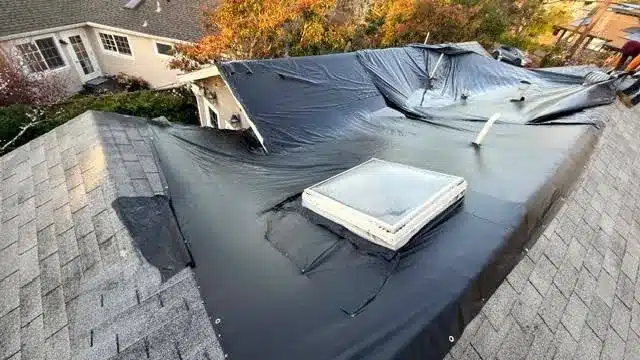
Undersized. The tarp covers the hole but not the area around it, so water tracks in from the edge and the homeowner is told the leak is “a different leak”.
Unfastened. Wind gets underneath, the tarp balloons and shifts overnight, and the roof is open again by morning — usually during the storm that made it necessary.
Punctured. Fasteners driven through the middle of the field with nothing sealing them, which is a roof with new holes in it.
What to do tonight, in order
- Stop the water reaching more of the house. Move furniture and electronics, put down buckets and containers, and if water is pooling in a ceiling, pierce the low point of the bulge with a screwdriver so it drains into a bucket rather than collapsing the whole panel. Turn off power to any circuit near active water.
- Photograph everything before it is touched. The failed tarp from outside and, if it is safe from a window or with a zoom, from a distance. The wet ceiling, walls and floors. Any standing water. Timestamps matter, so use your phone camera rather than tidying first.
- Write to the contractor, do not just call. A text or email creates a record: what you found, when, and that you are asking them to make it safe. Verbal promises are worth very little three weeks later when the drywall bill arrives.
- Get the roof properly contained. Either by the original contractor if you still trust them, or by someone else — an active leak does not wait for a liability argument to resolve. We dispatch 24 hours a day across the South Bay and Peninsula: (408) 685-2177.
- Call your insurer before demolition starts. Most policies want notice and their own view of the damage. A restoration company sent by the contractor who caused the problem is not a neutral record of it.
- Get an independent inspection in daylight. A second roofer’s written report on what failed, with photographs, is the document that settles who pays. Ours is free — see what a roof inspection covers.
Who pays when a tarp fails
It depends on why it failed, which is exactly why the photographs matter. If the tarp was inadequate — undersized, unfastened, nailed through the field — that is workmanship, and the contractor’s general liability insurance is the usual route. Their offer to “fix it themselves” is often genuine and often faster, but you are entitled to know who is doing the drywall and moisture remediation, and to insist that wet insulation and framing are dried and documented rather than closed up.
If the tarp was sound and an exceptional storm took it, that is closer to a claim on your own policy. And if the roof was already at the end of its life, the argument shifts again, which is another reason to get an independent opinion rather than accept the first account of what happened.
One thing homeowners often miss: acting immediately to limit damage is usually a condition of the policy itself. Tarping the roof and photographing the result is not just practical — it is evidence that you met that obligation, and it is what stops an insurer arguing that avoidable damage was your responsibility.
For what emergency containment involves and how quickly crews reach each part of the Bay Area, see our emergency roof tarping service. If the leak turns out to be a failed detail rather than storm damage, roof repair in San Jose covers what that work looks like — and a tile roof leak we repaired in Richmond shows how a leak gets traced back to its actual source rather than the stain on the ceiling.
Emergency tarping questions
How long should an emergency roof tarp stay on?+
Can I tarp the roof myself?+
Does homeowners insurance cover interior damage from a failed tarp?+
Water coming in right now?
Crews dispatch 24 hours a day across San Jose, the South Bay and the Peninsula, with insurance-ready photographs taken as standard. If it can wait until morning, book a free inspection and we will tell you honestly what failed.
Book a Free Inspection Call (408) 685-2177See recent projects · Lifetime Roofing & Renovation, Inc. · Sunnyvale, CA · CSLB #1090028 · 4.8★ on Google
Gina K. writes about Bay Area roofing for Lifetime Roofing & Renovation, drawing on the team's 16+ years of experience roofing homes across Silicon Valley.