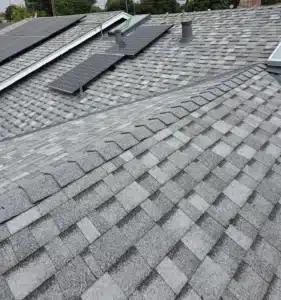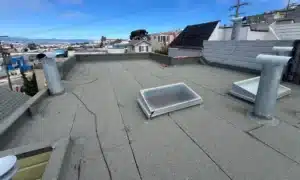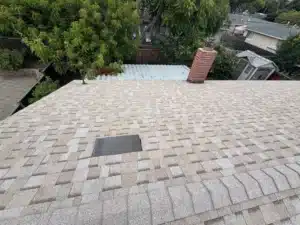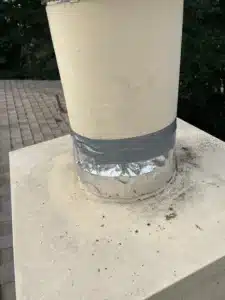
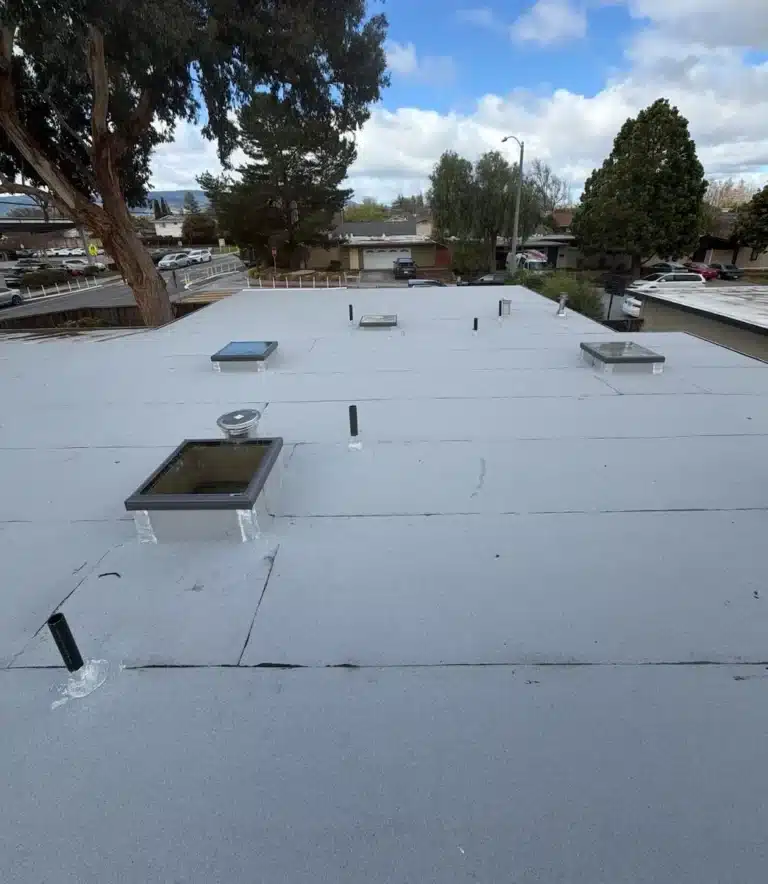
A mid-century home on Chickadee Court in Sunnyvale had a low-slope roof that was past the end of its life, so we rebuilt the whole assembly from the deck up: new structural sheathing across the entire roof, a new base sheet, a torch-applied modified bitumen cap sheet, new skylights on new curbs, and new metal vent flashings — closed out under a 20-year warranty. A flat roof quote looks big because a real flat roof replacement is a system, not a surface.
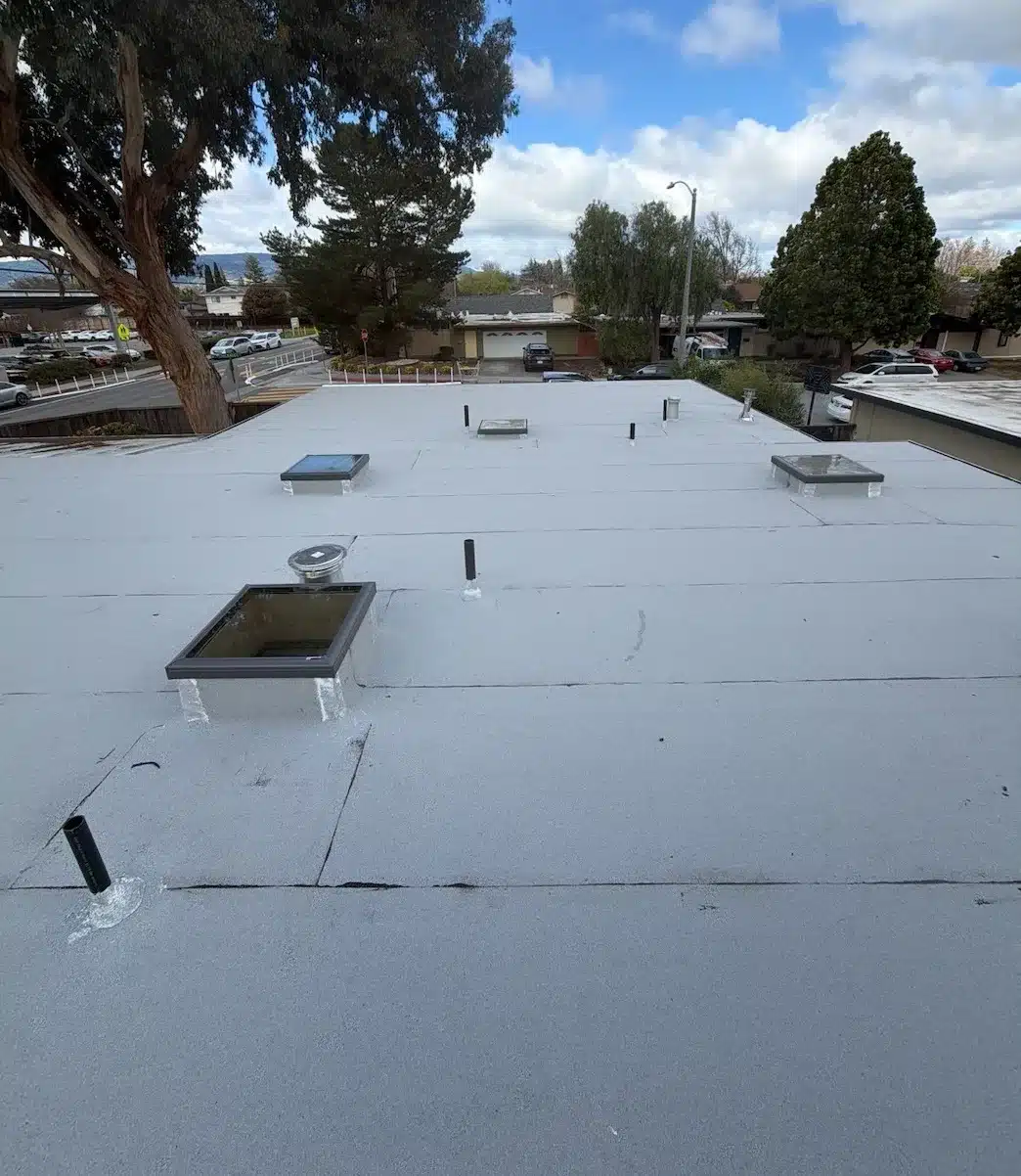
A proper flat roof replacement is a full system rebuilt from the deck up, not a fresh surface rolled over the old one. On this Sunnyvale project that meant stripping the old built-up roof down to the home’s original board decking, sheathing the entire roof in new structural panels, framing new curbs, laying a base sheet, and torching down a light-colored granulated modified bitumen cap sheet — plus new skylights and new metal vent flashings. That layering is why a low-slope quote is a different number from a shingle quote on the same square footage: you are paying for several plies of work and for every single penetration to be detailed by hand. Built that way, this roof went out the door with a 20-year warranty.
A Mid-Century Low-Slope Roof That Had Given All It Had
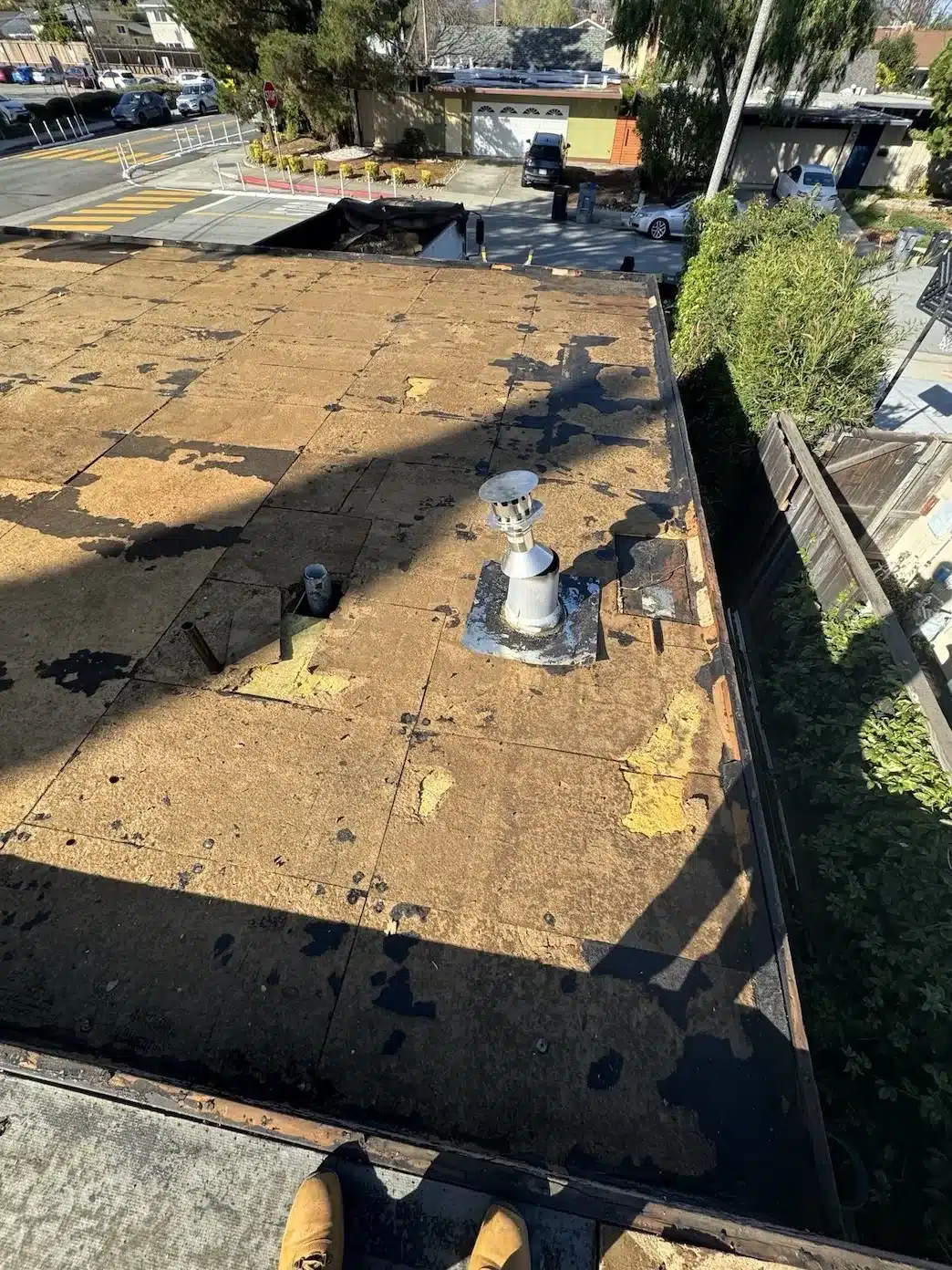
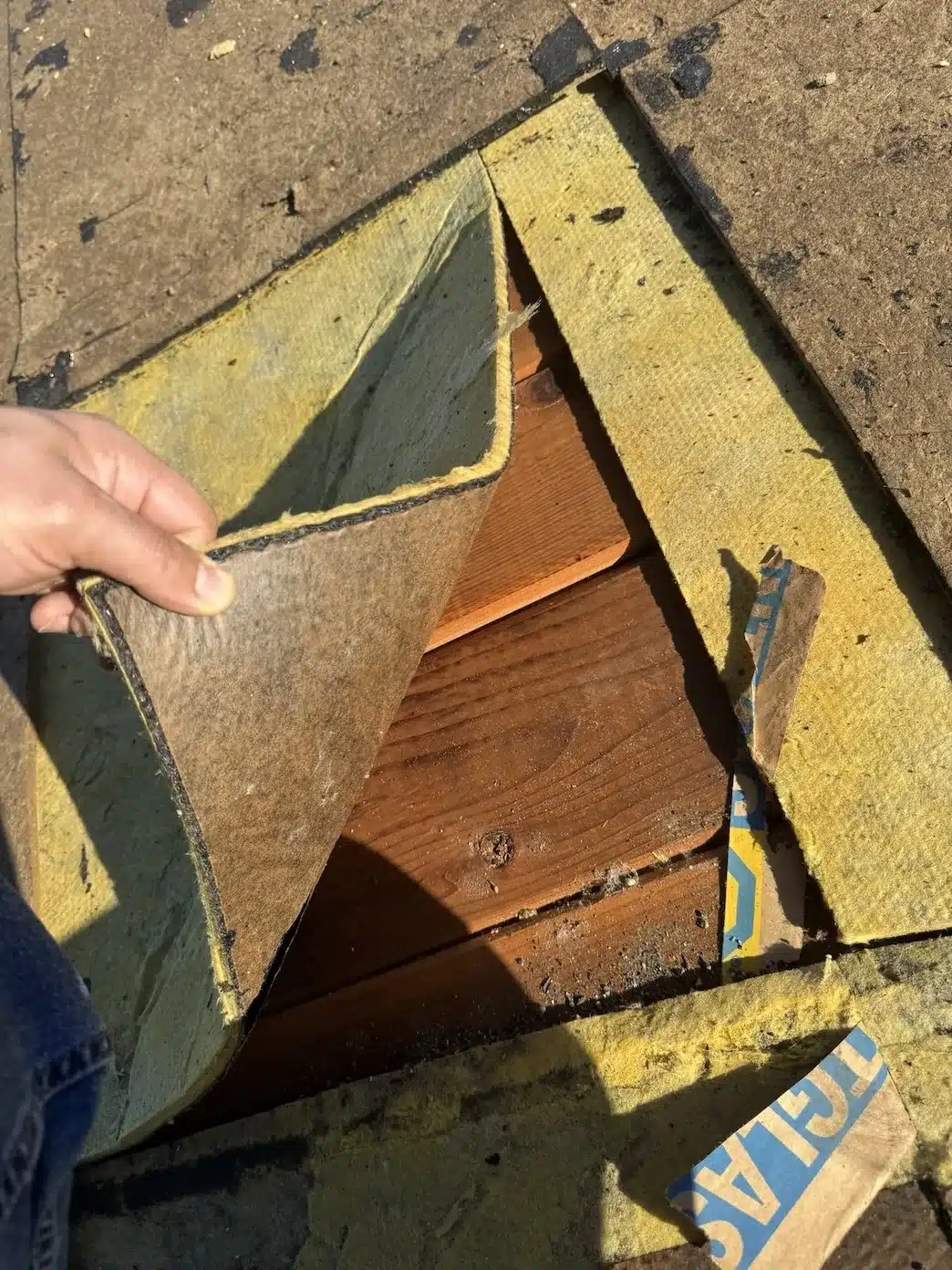
This is a post-and-beam home of the kind that fills this part of Sunnyvale: a broad, nearly flat roof with a shingled mansard band around the edge and skylights bringing daylight deep into the plan. Those roofs are wonderful to live under and unforgiving to maintain. When our crew stripped this one, the original assembly came into view — an old built-up roof over fiberglass insulation board, sitting on the home’s original 1x board decking. Years of spot repairs had left dark asphalt patches scattered across the field, and the fiberboard underneath had gone soft in places. There was no single dramatic hole to point at. The roof had simply reached the end, and one more patch would have been money spent on borrowed time.
Rebuilt From the Deck Up, Not Rolled Over the Top
The cheapest version of this job would have been an overlay — a new surface laid straight over what was already there. We didn’t do that, and the reason matters. An old 1x board deck moves: the boards cup, gap and telegraph every irregularity straight through a new membrane, and any soft substrate left underneath stays soft. So the entire roof got new structural sheathing first, giving the new system one flat, continuous, sound surface to bond to. On top of that went a base sheet, and then a torch-applied modified bitumen cap sheet with a light-colored granulated surface, heat-welded ply to ply. It is a multi-layer asphalt system rather than a single welded sheet, and on a residential low-slope roof with this many penetrations it is a workhorse. If you’re weighing a similar roof replacement, that deck decision is usually the one that separates two very different quotes.
Nine Days, Four Stages
The contract was signed on February 27, and the crew was tearing off that same day. Once the old roofing was down, new sheathing went across the whole roof, framing was opened up and rebuilt where the old openings needed it, and fresh curbs were built for the skylights so the new units would sit above the water line rather than in it. Staging matters on a low-slope job: everything you see waiting on the deck in the photo below — cap sheet rolls, vent stacks, new flashings — is there so the roof never sits open longer than it has to.
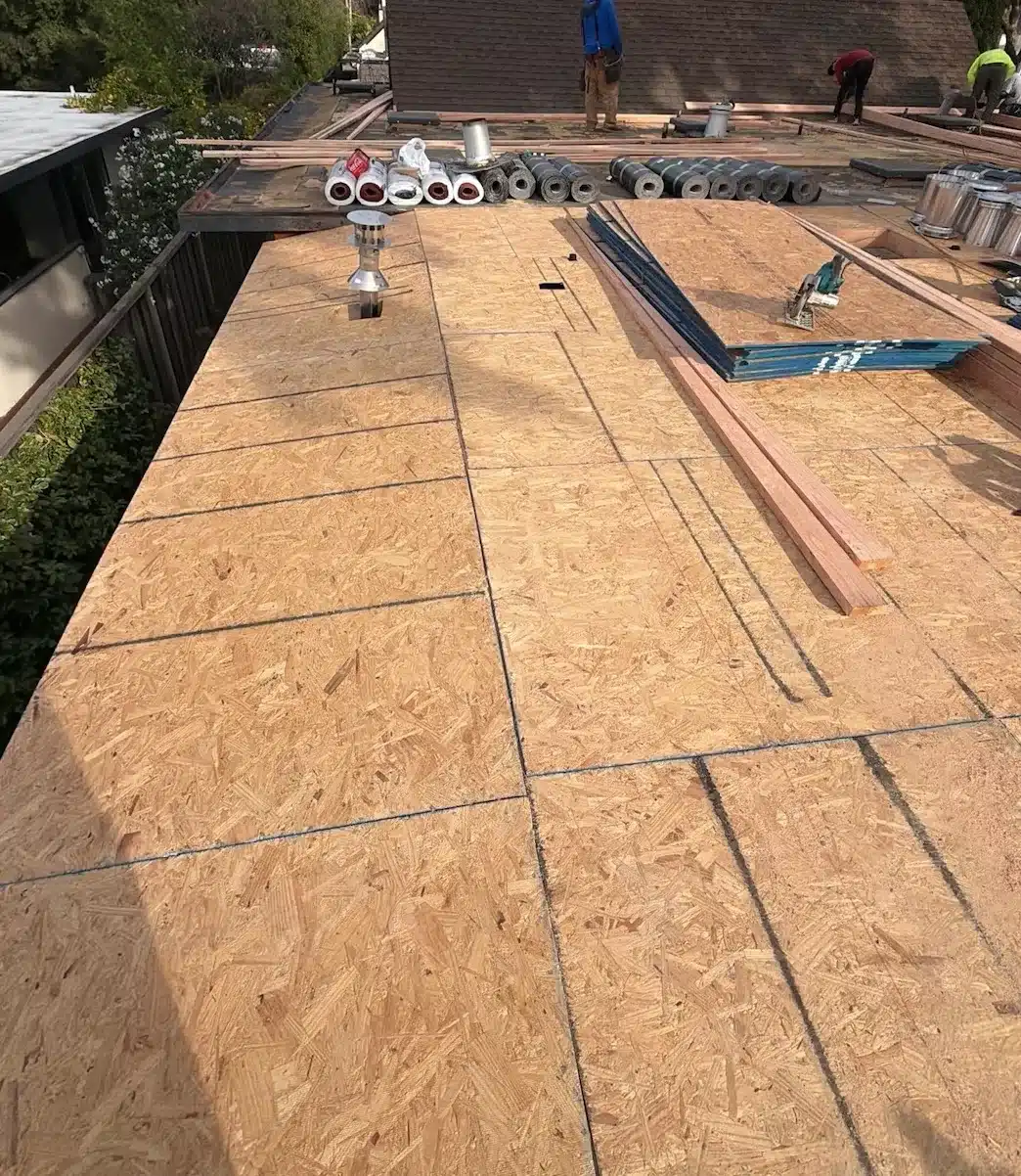
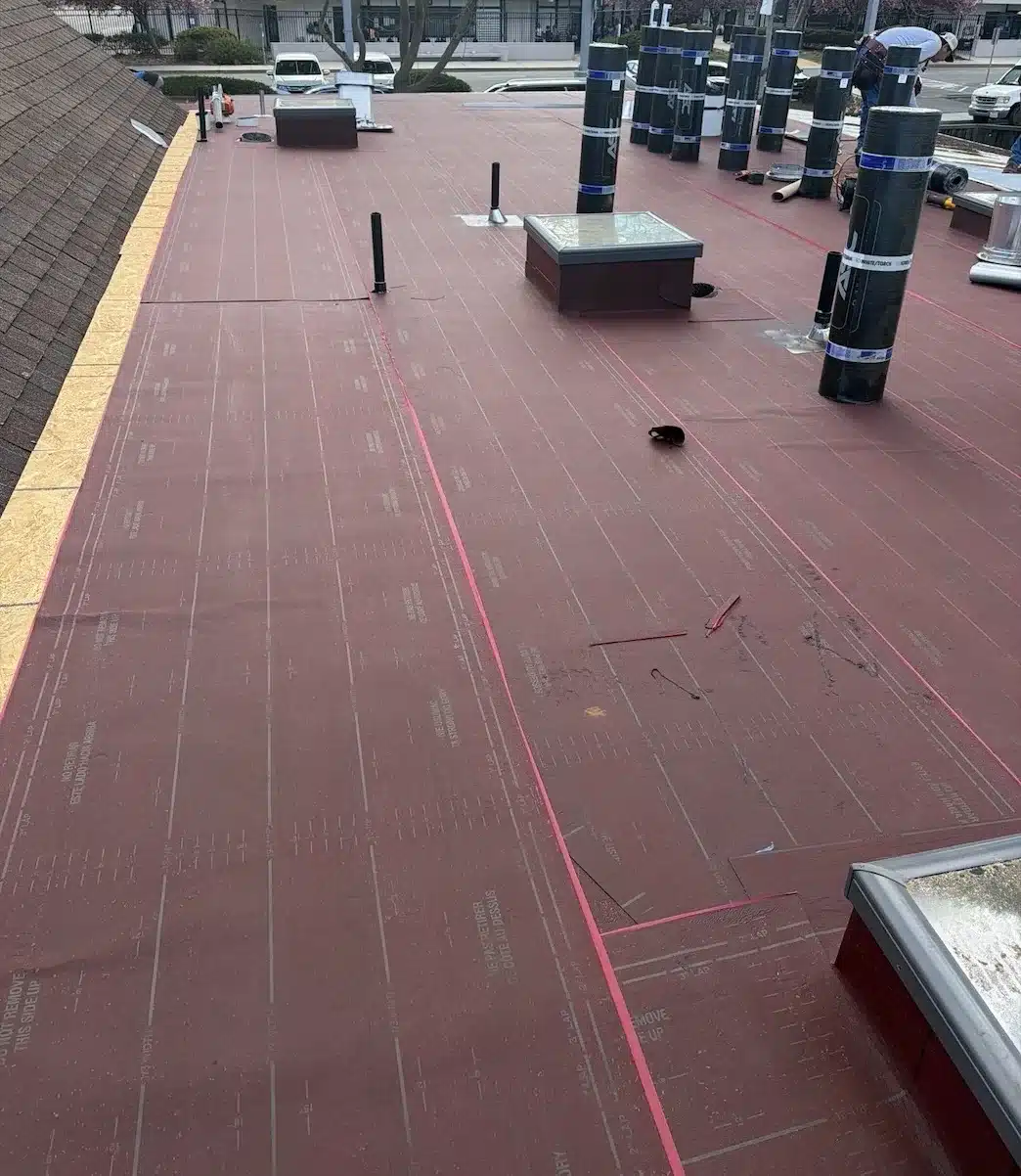
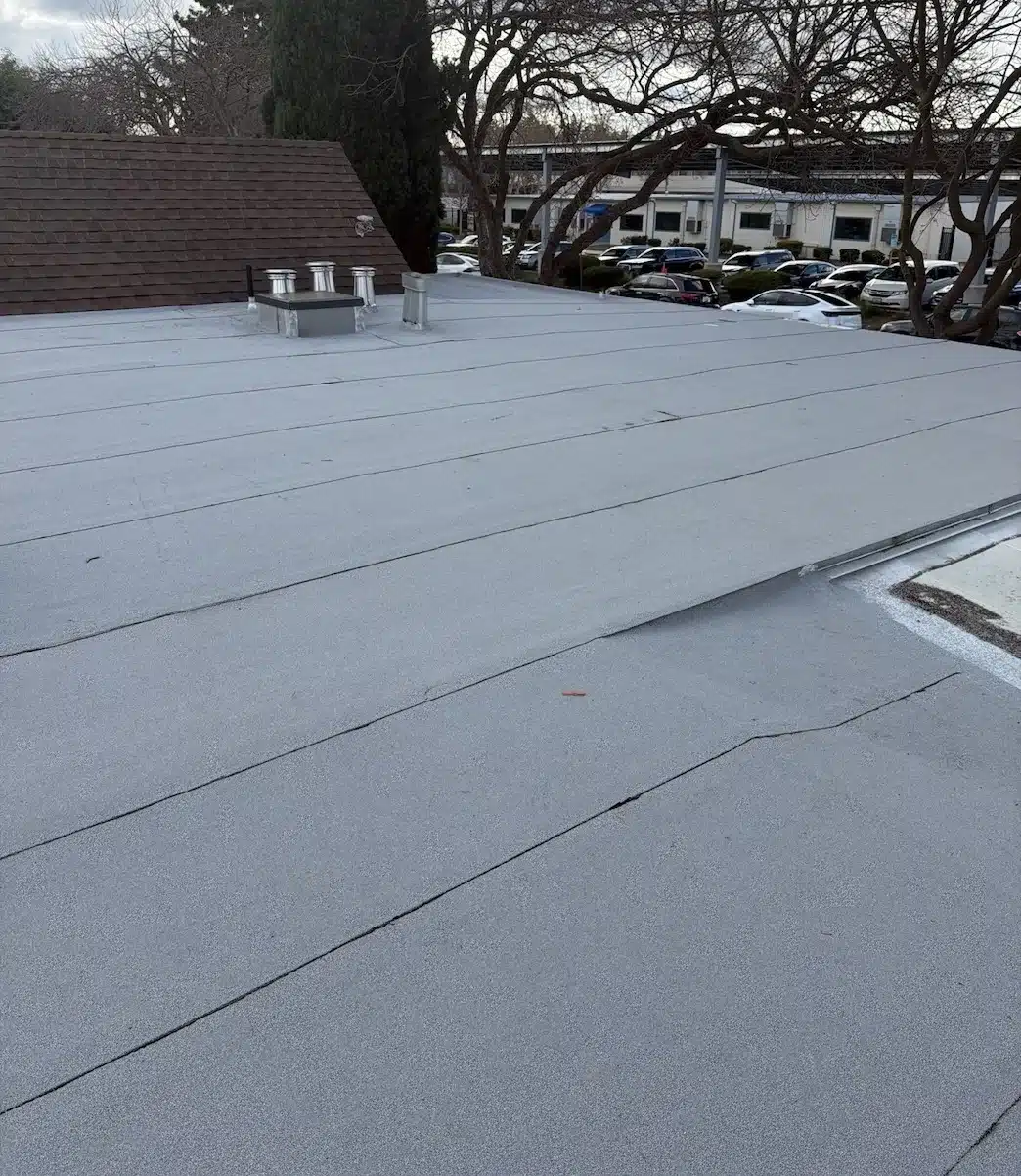
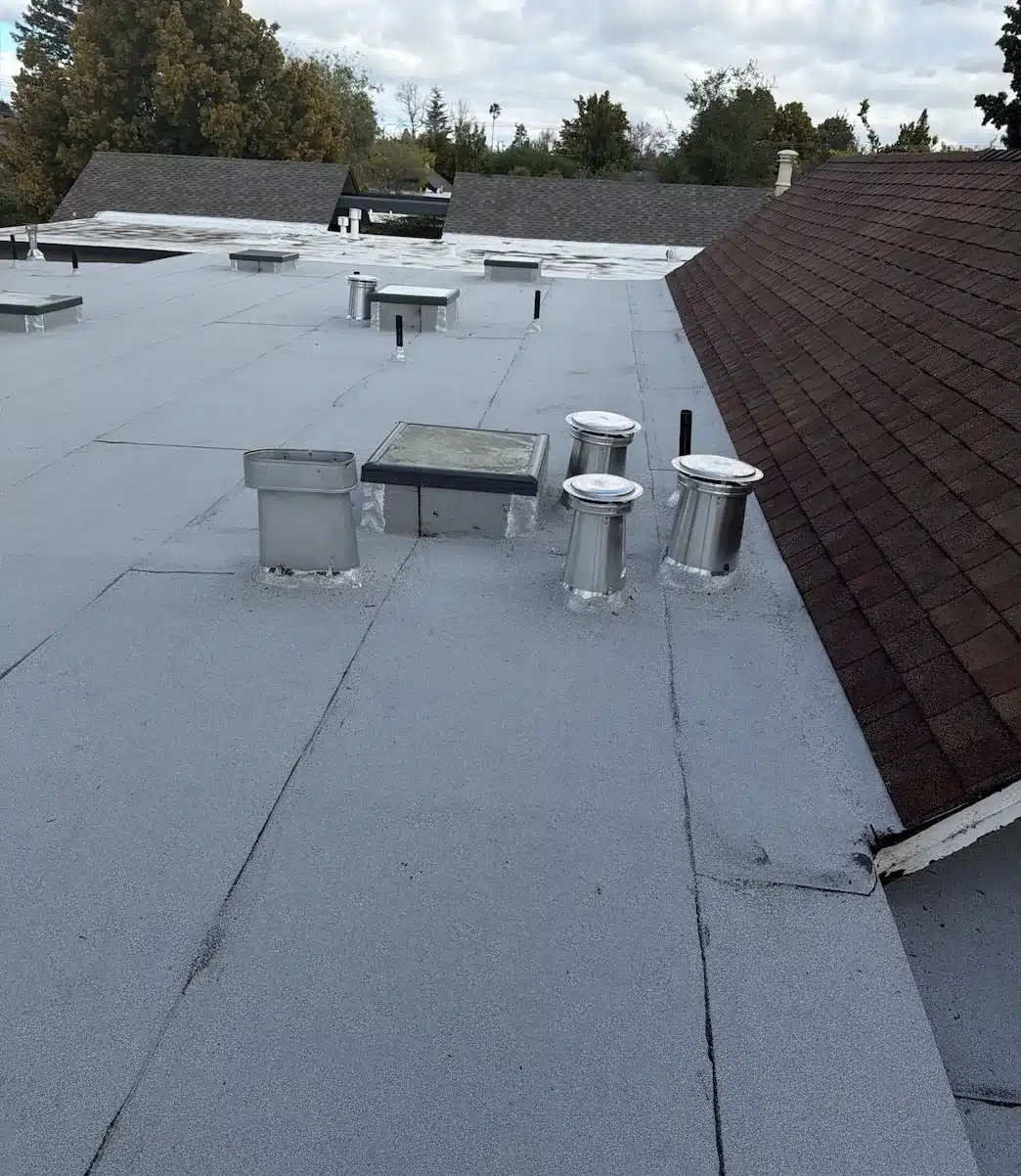
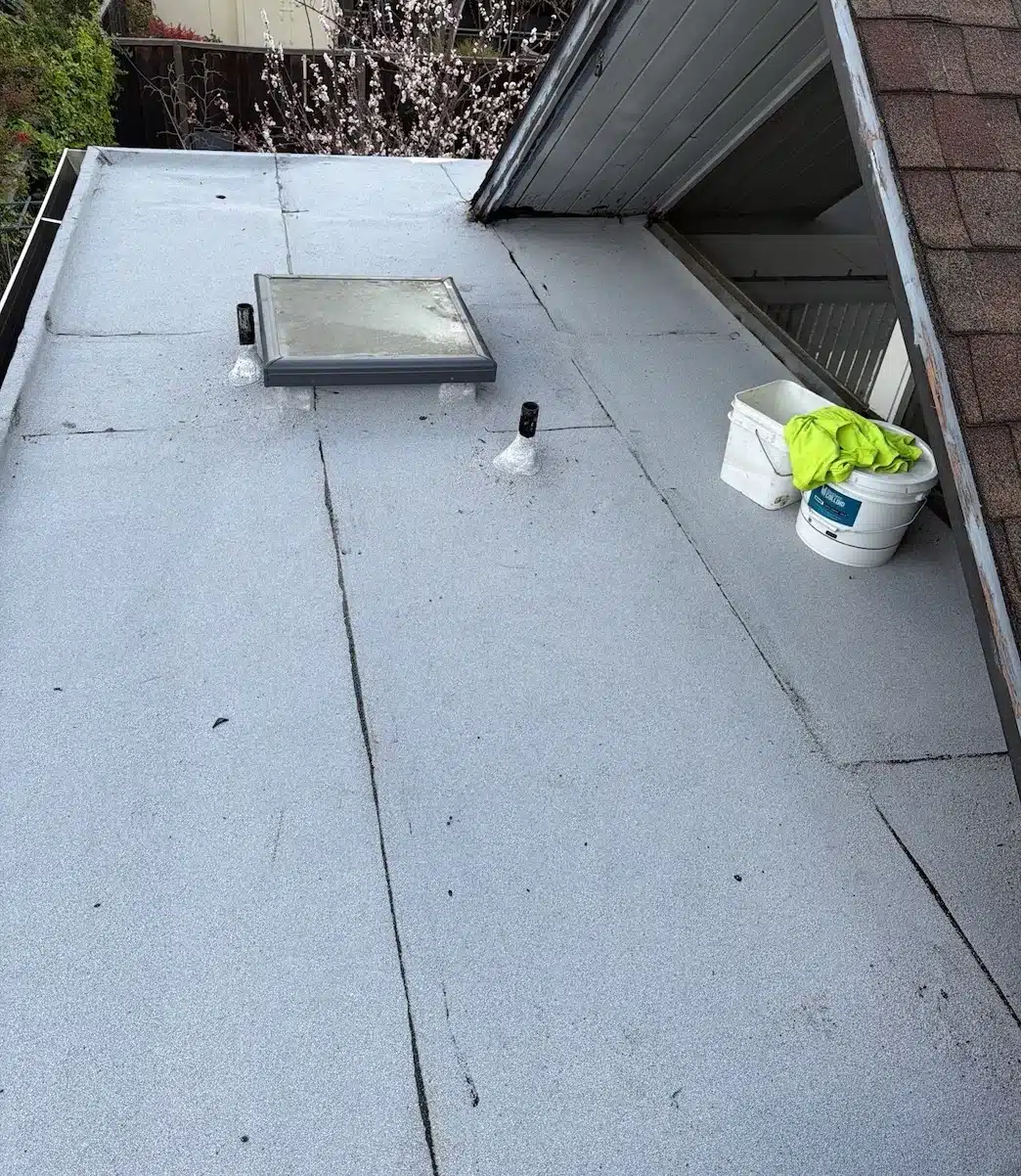
The base sheet went down on March 2 and the cap sheet on March 4, welded ply to ply and run up onto every curb. New skylights were set, new metal vent caps and flues went in, and each penetration was flashed and sealed by hand — the details you can see as small white collars in the finished photos. The job closed out on March 8, nine days from signature, with a 20-year warranty on the new system.
Before vs. After
| Feature | Before | After |
|---|---|---|
| Roof assembly | Aging built-up roof over fiberglass insulation board | Full system rebuilt: new sheathing, base sheet, torch-applied cap sheet |
| Deck | Original 1x board decking, cupped and repeatedly patched | New structural sheathing across the entire roof |
| Surface | Dark, worn, scattered with asphalt patch repairs | Light-colored granulated cap sheet, uniform across the field |
| Skylights | Original units on aging curbs | New skylights set on newly framed curbs |
| Penetrations | Old vents and flues, patched in the field | New metal vent caps and flues, each one flashed and sealed |
| Warranty | — | 20-year warranty, completed in nine days |
Why a Flat Roof Is a Different Job in Sunnyvale
Sunnyvale has a lot of these roofs. The mid-century tracts here were built with low-slope, post-and-beam construction, and that geometry changes the whole problem: a pitched roof sheds water, while a flat roof holds it until it evaporates or drains. There is no slope to rescue a sloppy detail, so every seam, curb and pipe becomes a place the roof can fail, and the only real defense is layers plus careful handwork at each penetration. Our climate adds its own pressure — five or six rainless months bake the surface, then winter storms arrive all at once and test everything at the same moment. It is also why a light-colored cap sheet is worth having: it runs cooler through a Santa Clara Valley summer than the dark, patched surface it replaced. If you’re still deciding what belongs on your own low-slope roof, our rundown of flat roof pros and cons is a good starting point, and you can see the rest of our roofing work in Sunnyvale here.
What Homeowners Ask Us About Flat Roof Replacement
Can you just install a new flat roof over the old one?
Sometimes it is permitted, but it is rarely the right call, and we did not do it here. An overlay traps whatever was failing underneath and inherits every flaw in the old deck, so an uneven substrate telegraphs straight through the new membrane. It also adds weight and buys you a shorter service life for most of the same labor. On this Sunnyvale roof the old board decking was cupped and patched, which made new sheathing the difference between a roof that lasts decades and one that looks fine for two winters. The longer answer — why a patch creates a new seam, and why seams are where flat roofs fail — is in why flat roof patches keep failing.
How long does a flat roof replacement take?
This one ran nine days from signed contract to closeout — tear-off and new sheathing on February 27, base sheet March 2, cap sheet March 4, final details and sign-off March 8. Size, the amount of deck and framing repair found once the old roof is off, and the weather window are what move that number. A low-slope roof is never left open overnight, so the schedule is built around getting each section dried in the same day it is opened.
What is a torch-applied modified bitumen roof, and how long does it last?
It is a multi-ply asphalt-based system: a base sheet goes down first, then a cap sheet is heat-welded to it so the plies fuse into one continuous membrane, with mineral granules on top for UV protection. It is not the same thing as a single-ply PVC or TPO membrane, which is a single welded sheet — modified bitumen suits a residential low-slope roof with a lot of penetrations, because the material can be worked around curbs and pipes by hand. This roof carries a 20-year warranty.
Got a Flat Roof Quote You Don’t Understand?
Ask us to walk you through it line by line — what’s coming off, what’s going back on, and what the warranty actually covers. See more finished work in our roofing projects.
Watch this project
A Sunnyvale flat roof rebuilt from the deck up: new sheathing, base sheet, torch-applied cap sheet, new skylights and vents.
Gina K. writes about Bay Area roofing for Lifetime Roofing & Renovation, drawing on the team's 16+ years of experience and 1,000+ completed roofs across Silicon Valley.