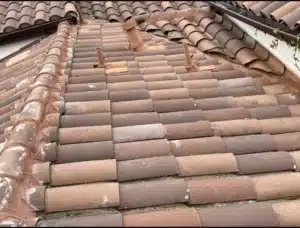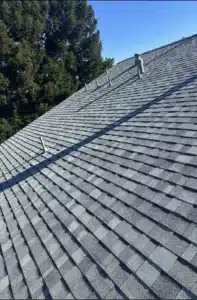

A leak on a brand new roof is frustrating, and the fix is rarely as dramatic as it first feels. The first job is to find the source. Only then can you tell whether a patch or a replacement is the honest answer.
Brand New Roof Is Leaking. What Justifies a Full Replacement vs. Patch Repairs?
Find the source of the leak before deciding anything. On a new roof, most leaks trace back to a few details: a flashing at a wall, chimney or skylight, a pipe boot or vent that was not sealed, a nail placed in the wrong spot, or a missed overlap in the underlayment. Those are normally repaired locally. A full replacement is justified when the problem is systemic, such as the wrong underlayment, fasteners driven incorrectly across the roof, or wet decking in several areas. Some drips on a new roof are not leaks at all. Condensation caused by poor attic ventilation, such as blocked intake vents, missing baffles, or a bath fan or vent that is not connected to the outside, can look just like a roof leak in cooler weather. Ask the installer to find and document the source, to test it, and to put the repair in writing before you decide.
This question was asked on Reddit’s r/Roofing in January 2026: read the original thread.
Two problems that look the same from the ceiling
A stain on the ceiling or a drip in the attic after the roofer has gone is alarming, but the cause matters. A true leak lets rain in through the roof. Condensation forms when warm, moist indoor air reaches cold sheathing and turns to water, which can drip, stain the underside of the deck and wet the insulation. A new roof can expose a ventilation problem that an older, leakier roof used to hide.
| What you see | More likely a leak | More likely ventilation |
|---|---|---|
| When it happens | During or right after rain | Cold mornings, with no recent rain |
| Where it shows | Below a flashing, valley, vent or skylight | Across the underside of the deck, often near the ridge |
| The attic | A trail of water from one spot | Damp insulation, frost or beaded moisture on nail tips |
| Bath fan or kitchen vent | Not a factor | Duct ends in the attic instead of outside |
A general guide, not a diagnosis. Some roofs have both problems at once, which is one reason a proper inspection beats guessing.
What actually justifies a full replacement
A patch is the right answer when the failure is local and the rest of the roof is sound. A flashing that was installed wrong, a pipe boot that cracked, or a section of shingles that was nailed high can be corrected without touching the rest of the roof. A new roof should also still be under the installer’s workmanship warranty, so start by calling them and asking for a written diagnosis.
Replacement starts to make sense when the defect is everywhere rather than somewhere. Examples include underlayment that is the wrong product for the roof, fasteners that were driven too deep or too high across whole slopes, deck boards that were left wet or damaged, or flashing details that were skipped throughout. If two or three different people point to the same widespread cause, a patch will only move the leak around. Ask for photos of what each person found, and compare their written scopes, not just their prices.
How attic ventilation is supposed to work
A balanced attic has air coming in low, at the eaves or soffit, and leaving high, at the ridge or roof vents. The intake side is the one most often forgotten. If the soffit vents are blocked by insulation, or baffles are missing so insulation has covered the vent path, the exhaust vents have nothing to pull from and the attic stays damp. California’s residential code sets a minimum amount of vent area relative to the attic floor, with some exceptions, so ask your local building department which rule applies to your roof.
We cover the standard approach on our roof ventilation page. If your roofer left the vents out entirely, see our post on what it means when a new roof has no vents, and if the leak only shows up once a year, this guide to intermittent leaks may help.
New roof leak questions
Is it normal for a brand new roof to leak?
No. A new roof should not leak, and a leak is a reason to call the installer right away. Many are caused by a small detail such as a flashing, a pipe boot or a fastener, and those are usually quick to correct. Keep photos and dates, because they matter if a warranty claim is needed.
How do I know if it is a leak or condensation?
Timing and location help. A leak usually appears during or soon after rain and traces to one spot. Condensation tends to show on cold mornings, across the underside of the deck, with damp insulation. A roofer or building-science inspector can check the attic and tell the two apart, and sometimes the answer is both.
Who pays to fix a leak on a new roof?
Check your contract and the warranty paperwork. Workmanship defects are normally the installer’s responsibility during the warranty period, while storm damage and other causes may be handled differently. Get the cause and the repair scope in writing so there is no confusion later.
Can poor ventilation make a roof leak?
It can cause water problems that look like a leak. Poor ventilation lets moist air condense on the roof deck, which can stain the ceiling, wet insulation and, over time, damage the sheathing. Fixing the intake and exhaust paths is usually part of the repair, not a replacement of the whole roof.
Not sure if it is a leak or a ventilation problem?
We will check the flashings, the attic and the vent paths, show you photos, and tell you honestly whether you need a repair or something more. Lifetime Roofing & Renovation, Inc., CSLB #1090028 (C-39).
Gina K. writes about Bay Area roofing for Lifetime Roofing & Renovation, drawing on the team's 16+ years of experience roofing homes across Silicon Valley.